Technetium
Technétium · Tc · 43
The first element made by human hands: all its isotopes are radioactive, and hardly any is left in nature. One of them is used every year in tens of millions of medical scans.
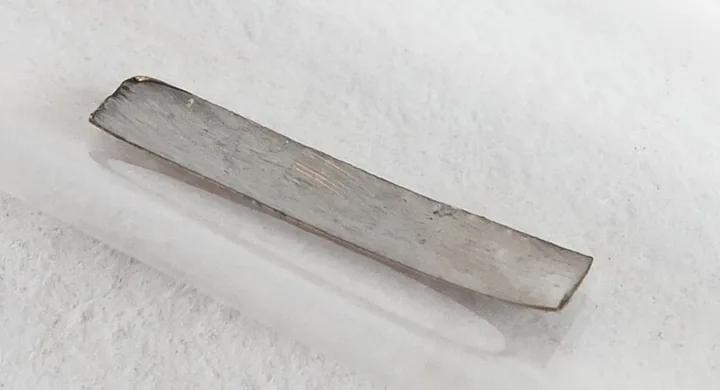
1Identity card
- Atomic number
- 43protons in the nucleus
- Symbol
- Tc
- Atomic weight
- [98]mass number of the most stable known isotope
- Family
- Transition metals
- Group · period · block
- 7 · 5 · d
- State at 20 °C
- solid
- Melting point
- 2,157 °C
- Boiling point
- 4,265 °C
- Density
- 11 g/cm³at 20 °C
- Electronegativity
- not defined
- Electron configuration
- [Kr] 4d5 5s2
- Electrons per shell
- 2 · 8 · 18 · 13 · 2
- Discovery
- 1937Carlo Perrier, Emilio Segrè
- Place
- Palermo (Italy)
2The technetium atom
An atom of technetium has 43 protons in its nucleus and, when neutral, as many electrons, spread over 5 shells.
3Discovery
Box 43 in Mendeleev’s table long stayed empty despite several false discoveries. In 1937, in Palermo, Carlo Perrier and Emilio Segrè analysed a molybdenum foil sent to them by Ernest Lawrence from Berkeley, where it had been bombarded with deuterium nuclei in a cyclotron.
They found atoms of a new, artificially created element in it. Natural traces would not be detected in uranium ores until the 1960s.
Want to know more about Mendeleev, Lawrence and other scientists? Visit Les inventeurs, a sister site devoted to scientists and their inventions (in French).
4Origin of the name
From the Greek tekhnētos, “artificial”, because it was the first element obtained by human hands.
5Where is it found?
Technetium has no stable isotope: whatever existed when the Earth formed has long since disappeared. Minute amounts form in uranium ores, and it is produced in nuclear reactors.
In 1952 the astronomer Paul Merrill detected technetium in the light of certain red giant stars: proof that stars make elements.
6Uses
- Technetium-99m: the most used isotope in nuclear medicine, for bone, heart, thyroid and lung scans.
- Research on corrosion and nuclear waste.
7Did you know?
Technetium-99m lives only a few hours: hospitals receive “generators” containing molybdenum-99, which slowly turns into technetium that is drawn off when a scan is due.
Safety: Radioactive; handled only in specialised laboratories.
8Isotopes
No stable isotope. The longest-lived, technetium-97 and technetium-98, have half-lives of about 4 million years; technetium-99 (211,000 years) is a waste product of power plants; technetium-99m (6 hours) is used in medical imaging.
9Its neighbours in the table
Elements in the same column often have similar chemistry; those in the same row have the same number of electron shells.