Iron
Fer · Fe · 26
The metal of civilisation: as steel, it makes up the vast majority of all metal used by humanity. It forms the core of the Earth, colours Mars red and carries oxygen in our blood.
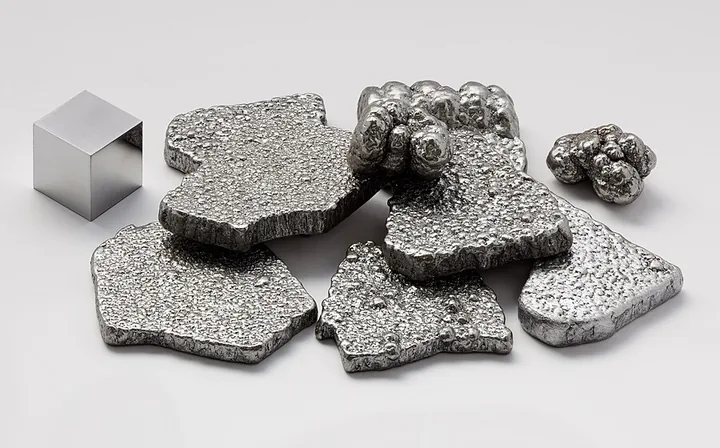
1Identity card
- Atomic number
- 26protons in the nucleus
- Symbol
- Fe
- Atomic weight
- 55.845 uIUPAC standard value
- Family
- Transition metals
- Group · period · block
- 8 · 4 · d
- State at 20 °C
- solid
- Melting point
- 1,538 °C
- Boiling point
- 2,861 °C
- Density
- 7.874 g/cm³at 20 °C
- Electronegativity
- 1.83Pauling scale
- Electron configuration
- [Ar] 3d6 4s2
- Electrons per shell
- 2 · 8 · 14 · 2
- Earth’s crust
- 5.6 %
- Discovery
- Known since antiquity
2The iron atom
An atom of iron has 26 protons in its nucleus and, when neutral, as many electrons, spread over 4 shells.
3Discovery
The first iron objects, Egyptian beads more than 5,000 years old, were hammered from meteoritic iron; Tutankhamun’s dagger has the same origin. Around 1500 to 1200 BCE, in the Near East, people learned to extract iron from its ores by heating them with charcoal.
Iron then spread across Europe and Asia: the Iron Age had begun. Blast furnaces appeared in China in antiquity and in Europe at the end of the Middle Ages.
4Origin of the name
The English word comes from Old English īsern; the symbol Fe comes from the Latin ferrum.
5Where is it found?
Iron is the fourth most abundant element in the Earth’s crust (about 5.6%), mainly in haematite and magnetite, mined notably in Australia, Brazil and China. The Earth’s core is made mostly of iron and nickel, so that by mass iron is the most abundant element in the planet as a whole.
The human body contains about 4 grams, mostly in the haemoglobin of red blood cells. In the Universe, iron is produced in abundance by massive stars and supernovae.
6Uses
- Steel for construction, cars, machinery, rails, ships and packaging.
- Cast iron for pipes, engines and pans.
- Magnets and the cores of electrical transformers.
- Catalyst for making ammonia.
7Did you know?
The Eiffel Tower contains about 7,300 tonnes of puddled iron; it is repainted roughly every seven years to protect it from rust.
Mars owes its red colour to iron oxide dust, in other words rust, covering its surface.
An iron pillar erected in Delhi, India, about 1,600 years ago still resists rust remarkably well.
8Isotopes
Four stable isotopes; iron-56 makes up about 92%. Iron-60, radioactive (half-life 2.6 million years), found in ocean sediments, is evidence of stars exploding near the Earth.
Isotopes found in nature and their abundance (CIAAW data)
9Its neighbours in the table
Elements in the same column often have similar chemistry; those in the same row have the same number of electron shells.