Ruthenium
Ruthénium · Ru · 44
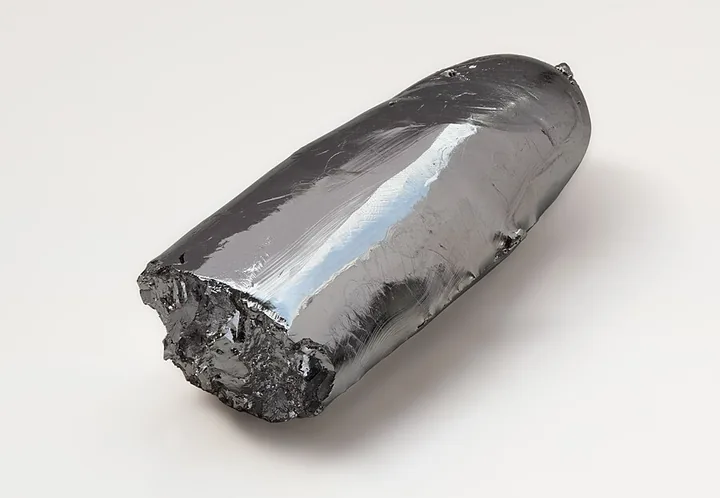
A hard, white metal of the platinum family, rare and precious. It is used in very thin layers in electronics and as a catalyst in chemistry.
1Identity card
- Atomic number
- 44protons in the nucleus
- Symbol
- Ru
- Atomic weight
- 101.07 uIUPAC standard value
- Family
- Transition metals
- Group · period · block
- 8 · 5 · d
- State at 20 °C
- solid
- Melting point
- 2,334 °C
- Boiling point
- 4,150 °C
- Density
- 12.45 g/cm³at 20 °C
- Electronegativity
- 2.2Pauling scale
- Electron configuration
- [Kr] 4d7 5s1
- Electrons per shell
- 2 · 8 · 18 · 15 · 1
- Earth’s crust
- 1.0 mg per tonne
- Discovery
- 1844Karl Ernst Claus
- Place
- Kazan (Russia)
2The ruthenium atom
An atom of ruthenium has 44 protons in its nucleus and, when neutral, as many electrons, spread over 5 shells.
3Discovery
Several chemists thought they had found it in the early 19th century in platinum ore residues. It was Karl Ernst Claus, a professor at the University of Kazan, who isolated it in 1844 from Ural platinum ore and proved that it was a new element.
4Origin of the name
From Ruthenia, a medieval Latin name for Russia, its discoverer’s country.
5Where is it found?
Very rare, ruthenium is recovered with the other platinum-group metals, mainly in South Africa and Russia.
6Uses
- Electrical contacts and resistors in electronic circuits.
- Catalysts for fine chemicals and pharmaceuticals.
- Hard alloys with platinum and palladium in jewellery.
7Did you know?
The 2005 Nobel Prize in Chemistry honoured ruthenium and molybdenum catalysts that let chemists “rearrange” molecules like dancers changing partners.
8Isotopes
Seven stable isotopes; ruthenium-102 is the most abundant (about 32%).
Isotopes found in nature and their abundance (CIAAW data)
9Its neighbours in the table
Elements in the same column often have similar chemistry; those in the same row have the same number of electron shells.