Cobalt
Cobalt · Co · 27
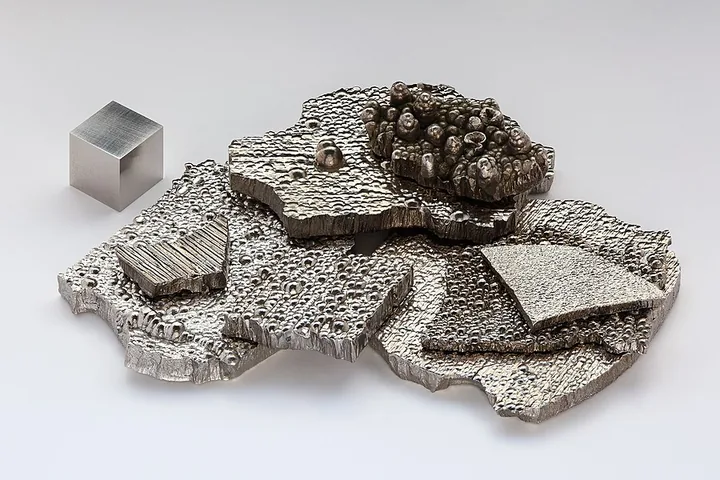
A hard, magnetic, bluish-grey metal. For millennia it gave its deep blue to glass and porcelain, and today it is one of the key metals in phone and car batteries.
1Identity card
- Atomic number
- 27protons in the nucleus
- Symbol
- Co
- Atomic weight
- 58.933 uIUPAC standard value : 58.933194
- Family
- Transition metals
- Group · period · block
- 9 · 4 · d
- State at 20 °C
- solid
- Melting point
- 1,495 °C
- Boiling point
- 2,927 °C
- Density
- 8.9 g/cm³at 20 °C
- Electronegativity
- 1.88Pauling scale
- Electron configuration
- [Ar] 3d7 4s2
- Electrons per shell
- 2 · 8 · 15 · 2
- Earth’s crust
- 25 g per tonne
- Discovery
- 1735Georg Brandt
- Place
- Stockholm (Sweden)
2The cobalt atom
An atom of cobalt has 27 protons in its nucleus and, when neutral, as many electrons, spread over 4 shells.
3Discovery
Egyptian glassmakers and Chinese potters already used cobalt ores to colour glass and porcelain blue, without knowing what they contained. The colour was often blamed on bismuth.
Around 1735, in Stockholm, the chemist Georg Brandt showed that the blue came from a new metal, which he isolated. It was the first metal discovered since antiquity whose discoverer is known.
4Origin of the name
From the German Kobold, a goblin of the mines. Miners blamed these mischievous spirits for replacing copper with a worthless ore that also gave off toxic arsenic fumes.
5Where is it found?
Cobalt is mostly extracted as a by-product of copper and nickel mining. The Democratic Republic of the Congo supplies about three quarters of world production, sometimes under very harsh working conditions.
6Uses
- Cathodes of lithium-ion batteries.
- Heat-resistant superalloys for jet engines and turbines.
- Permanent magnets and very hard cutting tools.
- Blue pigments for ceramics, glass and paints.
- Cobalt-60 for radiotherapy and sterilising medical equipment.
7Did you know?
Vitamin B12, which our bodies cannot do without, has a cobalt atom at its centre.
“Cobalt blue” has been one of painters’ favourite pigments since the 19th century.
8Isotopes
One stable isotope, cobalt-59. Cobalt-60, radioactive (half-life 5.3 years), emits very energetic gamma rays used in medicine and industry.
Isotopes found in nature and their abundance (CIAAW data)
9Its neighbours in the table
Elements in the same column often have similar chemistry; those in the same row have the same number of electron shells.