Palladium
Palladium · Pd · 46
A silvery-white metal of the platinum family that can absorb up to 900 times its own volume of hydrogen. It cleans up exhaust gases and helps chemists assemble molecules.
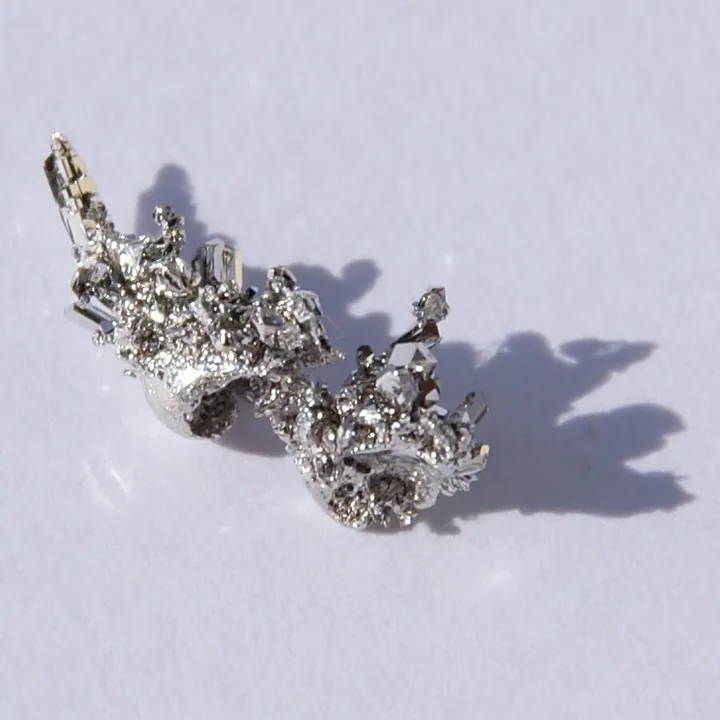
1Identity card
- Atomic number
- 46protons in the nucleus
- Symbol
- Pd
- Atomic weight
- 106.42 uIUPAC standard value
- Family
- Transition metals
- Group · period · block
- 10 · 5 · d
- State at 20 °C
- solid
- Melting point
- 1,554.8 °C
- Boiling point
- 2,963 °C
- Density
- 12.02 g/cm³at 20 °C
- Electronegativity
- 2.2Pauling scale
- Electron configuration
- [Kr] 4d10
- Electrons per shell
- 2 · 8 · 18 · 18
- Earth’s crust
- 15 mg per tonne
- Discovery
- 1803William Hyde Wollaston
- Place
- London (England)
2The palladium atom
An atom of palladium has 46 protons in its nucleus and, when neutral, as many electrons, spread over 4 shells.
3Discovery
In 1802, in London, William Hyde Wollaston extracted a new metal from platinum ore. Rather than publishing, he put it on sale anonymously in 1803 in a shop in Soho, as “new silver”. The chemist Richard Chenevix thought he had proved it was merely an alloy of platinum and mercury.
Wollaston only revealed himself as the discoverer in 1805, when he published his results.
4Origin of the name
From Pallas, an asteroid discovered in 1802, itself named after Pallas Athena, the Greek goddess of wisdom.
5Where is it found?
Palladium is mined mainly in Russia (Norilsk) and South Africa, often together with nickel and platinum.
6Uses
- Catalytic converters in petrol cars (about 80% of use).
- Electronic components (capacitors, contacts).
- Dental alloys and white-gold jewellery.
- Catalysts in pharmaceutical chemistry, and hydrogen purification.
7Did you know?
The 2010 Nobel Prize in Chemistry honoured palladium-catalysed reactions that let chemists snap complex molecules together like Lego bricks.
8Isotopes
Six stable isotopes; palladium-106 is the most abundant (about 27%).
Isotopes found in nature and their abundance (CIAAW data)
9Its neighbours in the table
Elements in the same column often have similar chemistry; those in the same row have the same number of electron shells.