Gold
Or · Au · 79
The yellow metal that has fascinated humanity since prehistoric times: it does not rust or tarnish and is easy to work. Jewellery, coins, electronics, satellites: it is wherever things need to shine and last.
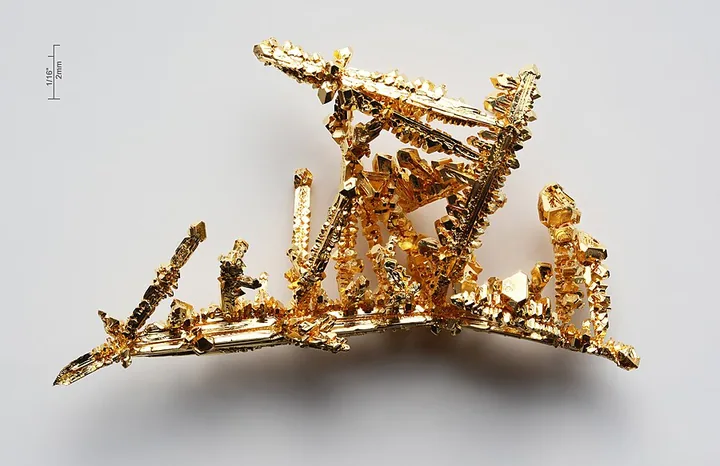
1Identity card
- Atomic number
- 79protons in the nucleus
- Symbol
- Au
- Atomic weight
- 196.97 uIUPAC standard value : 196.96657
- Family
- Transition metals
- Group · period · block
- 11 · 6 · d
- State at 20 °C
- solid
- Melting point
- 1,064.18 °C
- Boiling point
- 2,856 °C
- Density
- 19.3 g/cm³at 20 °C
- Electronegativity
- 2.54Pauling scale
- Electron configuration
- [Xe] 4f14 5d10 6s1
- Electrons per shell
- 2 · 8 · 18 · 32 · 18 · 1
- Earth’s crust
- 4.0 mg per tonne
- Discovery
- Known since prehistoric times
2The gold atom
An atom of gold has 79 protons in its nucleus and, when neutral, as many electrons, spread over 6 shells.
3Discovery
Gold occurs in native form, as nuggets and flakes: it was probably one of the first metals ever noticed. The oldest known gold treasure, found in the Varna necropolis in Bulgaria, is more than 6,000 years old.
The pharaohs of Egypt covered their tombs with it; Tutankhamun’s funeral mask contains more than 10 kilograms of gold. For centuries alchemists dreamed of turning lead into gold.
4Origin of the name
The English word is Germanic; the symbol Au comes from the Latin aurum, related to “aurora” and suggesting a brilliant glow.
5Where is it found?
Gold is mined from veins in quartz and from river sands, notably in China, Australia, Russia, Canada and the United States. Seawater contains minute traces.
Astronomers think that much of the gold in the Universe forms when neutron stars collide, like the collision observed in 2017.
6Uses
- Jewellery (about half of demand) and investment (bars, coins).
- Electronics: contacts and connectors that never oxidise.
- Space: gold films that reflect heat on satellites and astronauts’ visors.
- Dentistry and decoration (gold leaf).
7Did you know?
All the gold mined by humanity since the beginning of history would fit into a cube about 22 metres on each side.
A single gram of gold can be beaten into a sheet so thin it would cover almost a square metre.
8Isotopes
One stable isotope, gold-197.
Isotopes found in nature and their abundance (CIAAW data)
9Its neighbours in the table
Elements in the same column often have similar chemistry; those in the same row have the same number of electron shells.