Mercury
Mercure · Hg · 80
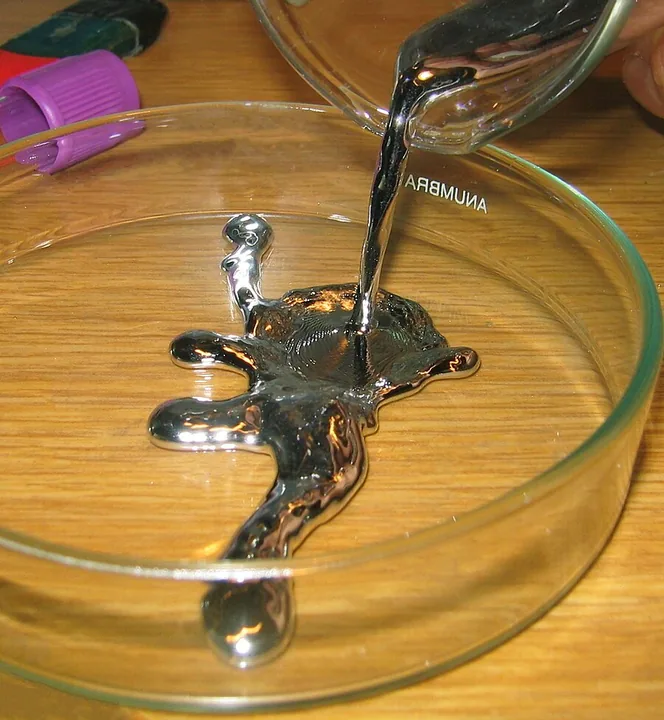
The only metal that is liquid at room temperature, mirror-bright and very dense. Long the king of thermometers and barometers, it is now banned from most uses because it is toxic.
1Identity card
- Atomic number
- 80protons in the nucleus
- Symbol
- Hg
- Atomic weight
- 200.59 uIUPAC standard value : 200.592
- Family
- Transition metals
- Group · period · block
- 12 · 6 · d
- State at 20 °C
- liquid
- Melting point
- −38.83 °C
- Boiling point
- 356.73 °C
- Density
- 13.534 g/cm³at 20 °C
- Electronegativity
- 2Pauling scale
- Electron configuration
- [Xe] 4f14 5d10 6s2
- Electrons per shell
- 2 · 8 · 18 · 32 · 18 · 2
- Earth’s crust
- 85 mg per tonne
- Discovery
- Known since antiquity
2The mercury atom
An atom of mercury has 80 protons in its nucleus and, when neutral, as many electrons, spread over 6 shells.
3Discovery
Mercury was known to the ancient Egyptians, Chinese and Indians: it has been found in tombs more than 3,000 years old. It was obtained by heating cinnabar, a bright red mineral also used as a pigment (vermilion).
The Almadén mine in Spain supplied it for more than two thousand years, until it closed in 2003.
4Origin of the name
From the Roman god Mercury, the swift messenger, like the droplets of this metal darting across a table. The symbol Hg comes from the Greek hydrargyros, “liquid silver”, also behind the old English name “quicksilver”.
5Where is it found?
Mercury is extracted from cinnabar (mercury sulfide); China is now the main producer. It is also released by volcanoes and by burning coal.
6Uses
- Formerly: thermometers, barometers, dental amalgams, batteries.
- Still today, in very small amounts, in some fluorescent lamps.
- Small-scale gold mining, a major source of pollution worldwide.
7Did you know?
In 1643 Evangelista Torricelli invented the barometer: air pressure holds up a column of about 760 millimetres of mercury, hence the unit “millimetre of mercury”.
In the 19th century hatters who used mercury salts to treat felt suffered from nervous disorders: this is the origin of the expression “mad as a hatter”.
Mercury is so dense that an iron ball floats on its surface.
Safety: Its vapour and organic compounds (such as the methylmercury in fish) are very toxic; the Minamata Convention, signed in 2013, limits its use worldwide.
8Isotopes
Seven stable isotopes; mercury-202 is the most abundant (about 30%).
Isotopes found in nature and their abundance (CIAAW data)
9Emission spectrum
As a gas or vapour, when heated or crossed by an electric current, mercury atoms give off light at a few very precise wavelengths: these are their lines, a true barcode of the element. Several elements were discovered by observing such lines in a spectroscope.
For listening, each light frequency is divided by 2⁴⁰: the light is transposed down forty octaves, which keeps the exact ratios between the lines. Point to or tap a line to hear it alone.
10Its neighbours in the table
Elements in the same column often have similar chemistry; those in the same row have the same number of electron shells.