Cadmium
Cadmium · Cd · 48
A soft, bluish and toxic metal, a cousin of zinc. It gave painters brilliant yellows and reds and long powered rechargeable batteries.
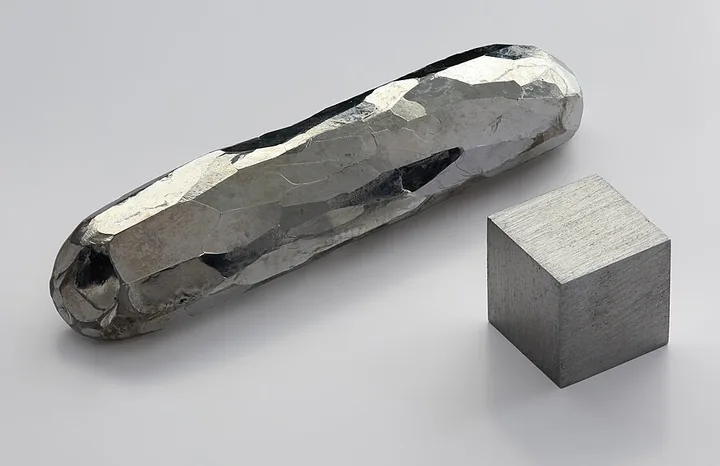
1Identity card
- Atomic number
- 48protons in the nucleus
- Symbol
- Cd
- Atomic weight
- 112.41 uIUPAC standard value : 112.414
- Family
- Transition metals
- Group · period · block
- 12 · 5 · d
- State at 20 °C
- solid
- Melting point
- 321.07 °C
- Boiling point
- 767 °C
- Density
- 8.65 g/cm³at 20 °C
- Electronegativity
- 1.69Pauling scale
- Electron configuration
- [Kr] 4d10 5s2
- Electrons per shell
- 2 · 8 · 18 · 18 · 2
- Earth’s crust
- 150 mg per tonne
- Discovery
- 1817Friedrich Stromeyer
- Place
- Göttingen (Germany)
2The cadmium atom
An atom of cadmium has 48 protons in its nucleus and, when neutral, as many electrons, spread over 5 shells.
3Discovery
In 1817, in Göttingen, Friedrich Stromeyer, an inspector of pharmacies, investigated a zinc carbonate that turned yellow when heated, although it contained no iron. He discovered that the colour came from an unknown metal, which he isolated the same year. Other German chemists made the same discovery almost at the same time.
4Origin of the name
From the Latin cadmia, the old name of calamine, the zinc ore in which it was found.
5Where is it found?
Cadmium is recovered as a by-product of zinc refining; there are no cadmium mines as such.
6Uses
- Cadmium telluride solar panels.
- Painters’ yellow, orange and red pigments.
- Control rods in some nuclear reactors, as it absorbs neutrons.
- Formerly, nickel–cadmium batteries (now almost banned in Europe).
7Did you know?
In Japan in the 20th century, cadmium pollution of a mining river caused itai-itai (“ouch-ouch”) disease, which made bones brittle and painful.
In 1907 the ångström, the spectroscopists’ unit of length, was defined using the red line of cadmium.
Safety: Toxic and carcinogenic; it builds up in the kidneys and bones.
8Isotopes
Eight natural isotopes; cadmium-114 and cadmium-112 are the most abundant. Cadmium-113 absorbs neutrons very strongly.
Isotopes found in nature and their abundance (CIAAW data)
9Emission spectrum
As a gas or vapour, when heated or crossed by an electric current, cadmium atoms give off light at a few very precise wavelengths: these are their lines, a true barcode of the element. Several elements were discovered by observing such lines in a spectroscope.
For listening, each light frequency is divided by 2⁴⁰: the light is transposed down forty octaves, which keeps the exact ratios between the lines. Point to or tap a line to hear it alone.
10Its neighbours in the table
Elements in the same column often have similar chemistry; those in the same row have the same number of electron shells.