Indium
Indium · In · 49
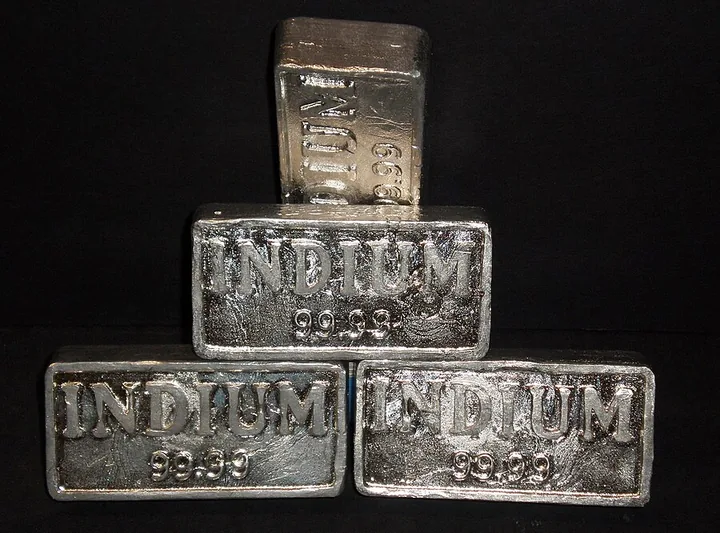
A silvery metal so soft that a fingernail can scratch it. As indium tin oxide, it makes touchscreens both transparent and electrically conductive.
1Identity card
- Atomic number
- 49protons in the nucleus
- Symbol
- In
- Atomic weight
- 114.82 uIUPAC standard value : 114.818
- Family
- Post-transition metals
- Group · period · block
- 13 · 5 · p
- State at 20 °C
- solid
- Melting point
- 156.6 °C
- Boiling point
- 2,072 °C
- Density
- 7.31 g/cm³at 20 °C
- Electronegativity
- 1.78Pauling scale
- Electron configuration
- [Kr] 4d10 5s2 5p1
- Electrons per shell
- 2 · 8 · 18 · 18 · 3
- Earth’s crust
- 250 mg per tonne
- Discovery
- 1863Ferdinand Reich, Hieronymus Theodor Richter
- Place
- Freiberg (Germany)
2The indium atom
An atom of indium has 49 protons in its nucleus and, when neutral, as many electrons, spread over 5 shells.
3Discovery
In 1863, in Freiberg, Saxony, Ferdinand Reich was looking for thallium in a zinc ore with a spectroscope. As he was colour-blind, he asked his assistant Hieronymus Theodor Richter to look for him. Richter saw a brilliant indigo-blue line never seen before.
The two chemists isolated the metal the following year.
4Origin of the name
From indigo, the colour of the line that revealed it.
5Where is it found?
Rare and scattered, indium is recovered as a by-product of zinc refining, mainly in China and South Korea.
6Uses
- Indium tin oxide (ITO): the transparent conductive layer in touchscreens, flat screens and some solar panels.
- Low-melting solders and seals for vacuum and extreme cold.
- Semiconductors (indium phosphide, indium gallium nitride) for LEDs and optical fibres.
7Did you know?
When a bar of indium is bent, it gives a little squeak, just like tin.
8Isotopes
Two natural isotopes. Curiously, the more abundant one, indium-115 (about 96%), is very weakly radioactive, while indium-113 is stable.
Isotopes found in nature and their abundance (CIAAW data)
9Emission spectrum
As a gas or vapour, when heated or crossed by an electric current, indium atoms give off light at a few very precise wavelengths: these are their lines, a true barcode of the element. Several elements were discovered by observing such lines in a spectroscope.
For listening, each light frequency is divided by 2⁴⁰: the light is transposed down forty octaves, which keeps the exact ratios between the lines. Point to or tap a line to hear it alone.
10Its neighbours in the table
Elements in the same column often have similar chemistry; those in the same row have the same number of electron shells.