Germanium
Germanium · Ge · 32
A shiny grey metalloid, a cousin of silicon. It was used to make the first transistors and today travels in optical fibres and infrared cameras.
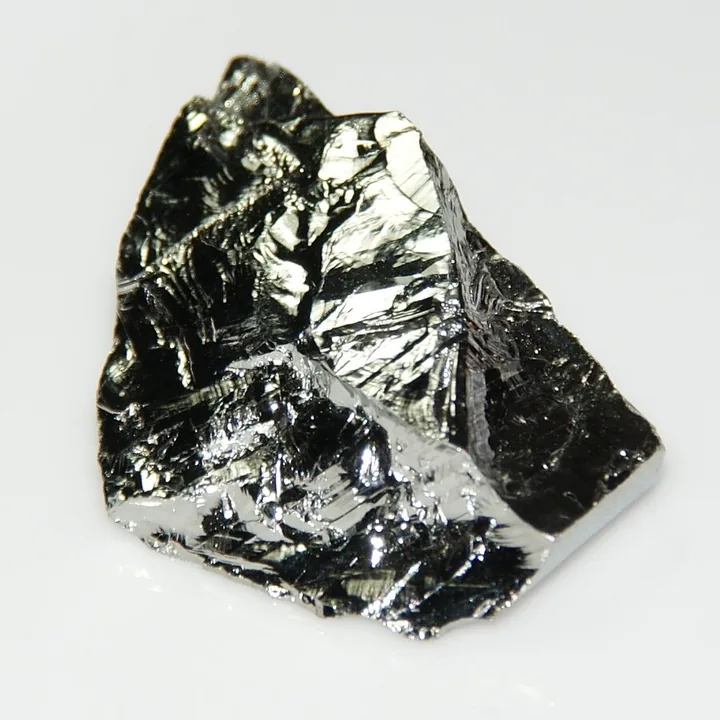
1Identity card
- Atomic number
- 32protons in the nucleus
- Symbol
- Ge
- Atomic weight
- 72.63 uIUPAC standard value
- Family
- Metalloids
- Group · period · block
- 14 · 4 · p
- State at 20 °C
- solid
- Melting point
- 938.25 °C
- Boiling point
- 2,833 °C
- Density
- 5.323 g/cm³at 20 °C
- Electronegativity
- 2.01Pauling scale
- Electron configuration
- [Ar] 3d10 4s2 4p2
- Electrons per shell
- 2 · 8 · 18 · 4
- Earth’s crust
- 1.5 g per tonne
- Discovery
- 1886Clemens Winkler
- Place
- Freiberg (Germany)
2The germanium atom
An atom of germanium has 32 protons in its nucleus and, when neutral, as many electrons, spread over 4 shells.
3Discovery
In 1871 Mendeleev announced an “eka-silicon” and described its mass, density and compounds. In 1886, in Freiberg, Saxony, Clemens Winkler analysed a silver mineral, argyrodite, and found that about 7% was missing from his results. He tracked down the missing element and isolated it.
Germanium’s properties matched Mendeleev’s forecasts strikingly: it was the finest confirmation of his table.
Want to know more about Mendeleev and other scientists? Visit Les inventeurs, a sister site devoted to scientists and their inventions (in French).
4Origin of the name
From Germania, the Latin name for Germany, its discoverer’s country.
5Where is it found?
Germanium is recovered as a by-product of zinc refining and from some coal ashes. China is the main producer.
6Uses
7Did you know?
The first transistor, invented in 1947 at Bell Labs, was made of germanium; silicon replaced it in the 1960s.
Mendeleev had forecast an atomic weight of 72 and a density of 5.5; the measured values were 72.6 and 5.35.
8Isotopes
Five natural isotopes; germanium-74 is the most abundant (about 36%).
Isotopes found in nature and their abundance (CIAAW data)
9Its neighbours in the table
Elements in the same column often have similar chemistry; those in the same row have the same number of electron shells.