Antimony
Antimoine · Sb · 51
A shiny, brittle, silvery-grey metalloid. Known in antiquity as an eye cosmetic, today it slows the spread of flames in plastics.
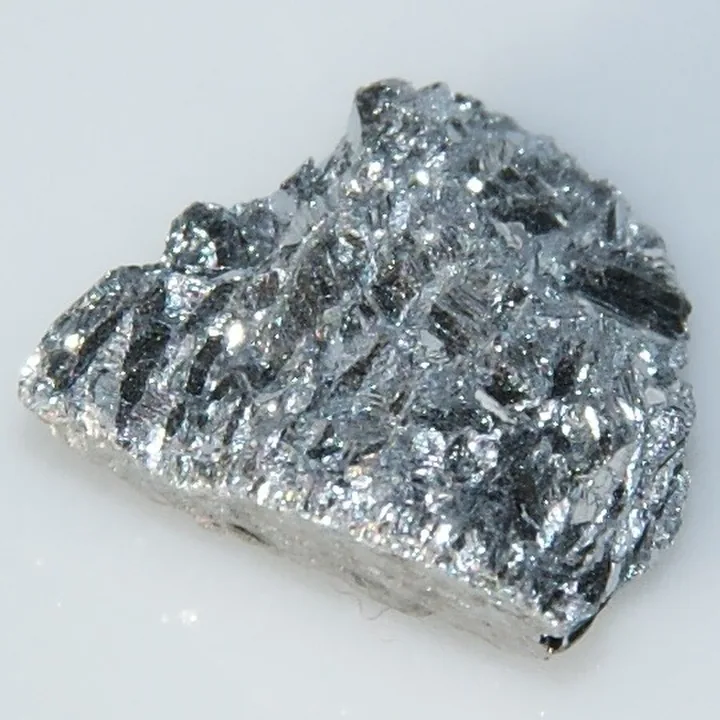
1Identity card
- Atomic number
- 51protons in the nucleus
- Symbol
- Sb
- Atomic weight
- 121.76 uIUPAC standard value
- Family
- Metalloids
- Group · period · block
- 15 · 5 · p
- State at 20 °C
- solid
- Melting point
- 630.63 °C
- Boiling point
- 1,587 °C
- Density
- 6.697 g/cm³at 20 °C
- Electronegativity
- 2.05Pauling scale
- Electron configuration
- [Kr] 4d10 5s2 5p3
- Electrons per shell
- 2 · 8 · 18 · 18 · 5
- Earth’s crust
- 200 mg per tonne
- Discovery
- Known since antiquity
2The antimony atom
An atom of antimony has 51 protons in its nucleus and, when neutral, as many electrons, spread over 5 shells.
3Discovery
Stibnite, a shiny black antimony sulfide, was used by Egyptian women as kohl to line their eyes. A fragment of a vase made of almost pure antimony, found in Mesopotamia, may be about 5,000 years old.
The metal was well described in Europe in the 16th century, notably by the Italian Vannoccio Biringuccio, then studied by alchemists and 17th-century chemists.
4Origin of the name
From the medieval Latin antimonium, of uncertain origin; the story that it poisoned monks (“anti-monk”) is a legend. The symbol Sb comes from stibium, the Latin name of stibnite.
5Where is it found?
It is mainly extracted from stibnite, in China, Russia and Tajikistan.
6Uses
7Did you know?
The printing type of Gutenberg and his successors was made of an alloy of lead, tin and antimony. Antimony, which expands slightly as it cools, gave the letters crisp edges.
Safety: Toxic, like most of its compounds.
8Isotopes
Two stable isotopes, antimony-121 (about 57%) and antimony-123 (about 43%).
Isotopes found in nature and their abundance (CIAAW data)
9Its neighbours in the table
Elements in the same column often have similar chemistry; those in the same row have the same number of electron shells.