Tellurium
Tellure · Te · 52
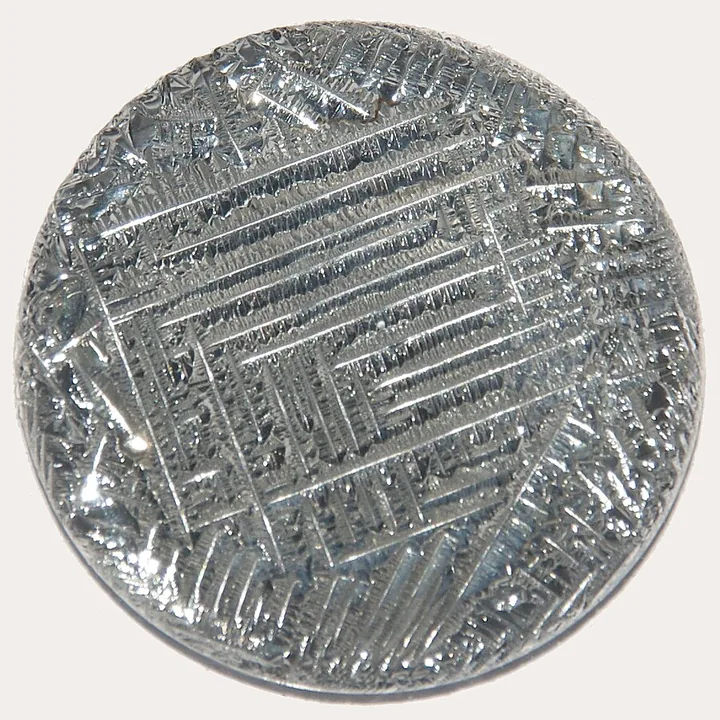
A brittle, silvery-white metalloid and one of the rarest elements in the Earth’s crust. It goes into solar panels, electronic coolers and old rewritable discs.
1Identity card
- Atomic number
- 52protons in the nucleus
- Symbol
- Te
- Atomic weight
- 127.6 uIUPAC standard value
- Family
- Metalloids
- Group · period · block
- 16 · 5 · p
- State at 20 °C
- solid
- Melting point
- 449.51 °C
- Boiling point
- 988 °C
- Density
- 6.24 g/cm³at 20 °C
- Electronegativity
- 2.1Pauling scale
- Electron configuration
- [Kr] 4d10 5s2 5p4
- Electrons per shell
- 2 · 8 · 18 · 18 · 6
- Earth’s crust
- 1.0 mg per tonne
- Discovery
- 1782Franz-Joseph Müller von Reichenstein; Martin Heinrich Klaproth (1798)
- Place
- Sibiu (Transylvania, now Romania)
2The tellurium atom
An atom of tellurium has 52 protons in its nucleus and, when neutral, as many electrons, spread over 5 shells.
3Discovery
In 1782, in Sibiu, Transylvania, the mining engineer Franz-Joseph Müller von Reichenstein studied a gold ore that gave puzzling results. He suspected a new metal, which he called “problematic metal”.
Sixteen years later, in Berlin, Martin Heinrich Klaproth confirmed the discovery and named the element, giving Müller credit for finding it.
Want to know more about Klaproth and other scientists? Visit Les inventeurs, a sister site devoted to scientists and their inventions (in French).
4Origin of the name
From the Latin tellus, “the Earth”.
5Where is it found?
Very rare, tellurium is recovered during copper refining. With gold it forms minerals called tellurides.
6Uses
7Did you know?
In 1896, in Kalgoorlie, Australia, prospectors filled potholes with an ore they thought was worthless… before discovering it was a gold telluride. The streets were then dug up!
Even slight exposure to tellurium gives a garlic smell to the breath that can last for weeks.
Safety: Toxic; its compounds must be handled with care.
8Isotopes
Eight natural isotopes. Tellurium-128, very slightly radioactive, has the longest half-life ever measured, about 2 × 10²⁴ years, hundreds of trillions of times the age of the Universe.
Isotopes found in nature and their abundance (CIAAW data)
9Its neighbours in the table
Elements in the same column often have similar chemistry; those in the same row have the same number of electron shells.