Arsenic
Arsenic · As · 33
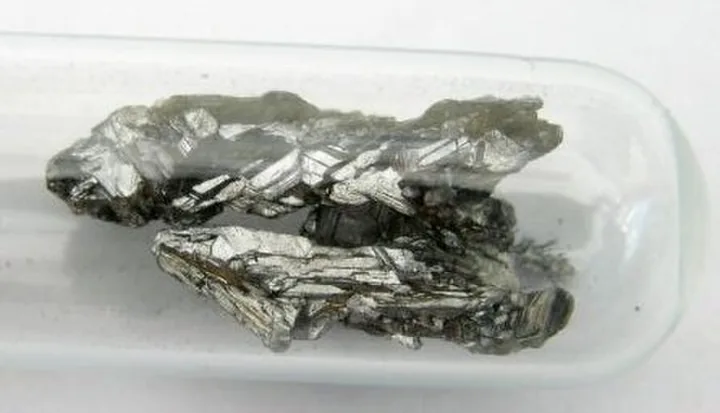
A grey metalloid whose name is inseparable from the history of poisons. Yet it is also used to make semiconductors and even a medicine against a form of leukaemia.
1Identity card
- Atomic number
- 33protons in the nucleus
- Symbol
- As
- Atomic weight
- 74.922 uIUPAC standard value : 74.921595
- Family
- Metalloids
- Group · period · block
- 15 · 4 · p
- State at 20 °C
- solid
- Melting point
- 817 °Conly under pressure
- Boiling point
- 616 °Csublimation: the solid turns straight into gas
- Density
- 5.727 g/cm³at 20 °C
- Electronegativity
- 2.18Pauling scale
- Electron configuration
- [Ar] 3d10 4s2 4p3
- Electrons per shell
- 2 · 8 · 18 · 5
- Earth’s crust
- 1.8 g per tonne
- Discovery
- 1250Albertus Magnus
- Place
- Germany
2The arsenic atom
An atom of arsenic has 33 protons in its nucleus and, when neutral, as many electrons, spread over 4 shells.
3Discovery
Arsenic sulfides, yellow (orpiment) and red (realgar), were used as pigments and remedies in antiquity. Around 1250, in Germany, the Dominican scholar Albertus Magnus obtained the element itself by heating orpiment with soap: it is one of the first elements isolated by a known author.
In the 19th century arsenic became notorious as “inheritance powder”. In 1836 the English chemist James Marsh devised a test able to detect minute traces of it, used in France as early as the trial of Marie Lafarge in 1840.
4Origin of the name
From the Greek arsenikon, the name of orpiment, itself from the Persian zarnikh, “gold-coloured”.
5Where is it found?
Arsenic is recovered when smelting copper and gold ores; its main mineral is arsenopyrite. Naturally present in some rocks, it contaminates well water in several parts of the world, notably Bangladesh.
6Uses
7Did you know?
In 1910 Paul Ehrlich launched Salvarsan, an arsenic compound against syphilis: one of the first synthetic drugs targeting a microbe.
In the 19th century a green arsenic pigment, “Scheele’s green”, coloured wallpapers and dresses… and made people living with them ill.
Safety: Arsenic and its compounds are highly toxic and carcinogenic.
8Isotopes
One stable isotope, arsenic-75.
Isotopes found in nature and their abundance (CIAAW data)
9Its neighbours in the table
Elements in the same column often have similar chemistry; those in the same row have the same number of electron shells.