Sulfur
Soufre · S · 16
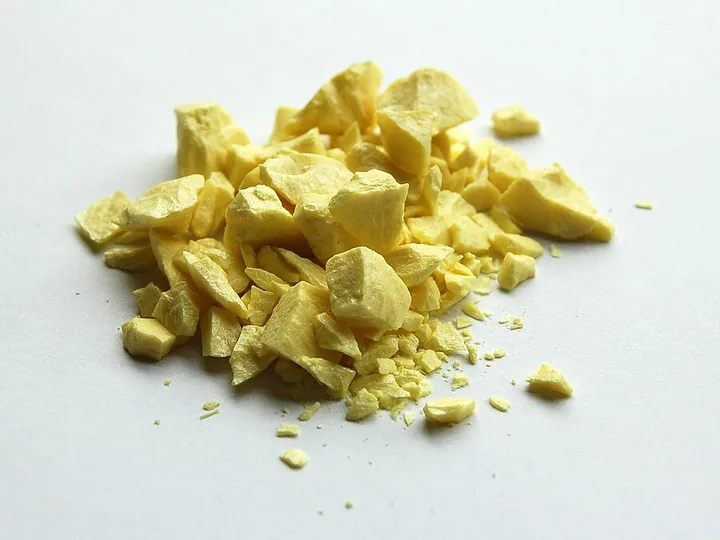
A bright yellow non-metal known since antiquity. People think it stinks, but pure sulfur hardly smells at all; it goes into sulfuric acid, the most produced chemical in the world.
1Identity card
- Atomic number
- 16protons in the nucleus
- Symbol
- S
- Atomic weight
- 32.06 uIUPAC standard value
- Family
- Other non-metals
- Group · period · block
- 16 · 3 · p
- State at 20 °C
- solid
- Melting point
- 115.21 °C
- Boiling point
- 444.61 °C
- Density
- 2.07 g/cm³at 20 °C
- Electronegativity
- 2.58Pauling scale
- Electron configuration
- [Ne] 3s2 3p4
- Electrons per shell
- 2 · 8 · 6
- Earth’s crust
- 350 g per tonne
- Discovery
- Known since antiquity
2The sulfur atom
An atom of sulfur has 16 protons in its nucleus and, when neutral, as many electrons, spread over 3 shells.
3Discovery
Sulfur can be picked up in pure form near volcanoes and hot springs, so it has been known since earliest antiquity. The Greeks and Romans burned it to purify houses, and the Bible links it to fire as “brimstone”.
Alchemists made it one of the principles of matter. In 1777 Antoine Lavoisier showed that it is a simple substance that combines with oxygen when it burns.
Want to know more about Lavoisier and other scientists? Visit Les inventeurs, a sister site devoted to scientists and their inventions (in French).
4Origin of the name
From the Latin sulfur or sulphur, of ancient and uncertain origin. IUPAC recommends the spelling “sulfur”.
5Where is it found?
Native sulfur is found around volcanoes, along with many sulfur minerals: pyrite (“fool’s gold”), galena, gypsum. Today most sulfur is recovered while purifying oil and natural gas.
The human body contains about 140 grams, notably in the proteins of hair and nails.
6Uses
7Did you know?
The smell of rotten eggs is not sulfur itself but hydrogen sulfide, a toxic gas produced when organic matter decays.
Io, a moon of Jupiter, is covered with active volcanoes that spew sulfur: it is yellow, orange and red.
Sulfur burns with a blue flame, which can be seen at night on some volcanoes in Indonesia.
Safety: Burning it produces sulfur dioxide, an irritating and toxic gas.
8Isotopes
Four stable isotopes, sulfur-32 (about 95%), sulfur-34 (4.4%), sulfur-33 (0.8%) and sulfur-36 (0.02%).
Isotopes found in nature and their abundance (CIAAW data)
9Its neighbours in the table
Elements in the same column often have similar chemistry; those in the same row have the same number of electron shells.