Nitrogen
Azote · N · 7
The main gas in the air we breathe, colourless, odourless and unreactive. Essential to life, since it is part of proteins and DNA, it also feeds crops as fertiliser.
1Identity card
- Atomic number
- 7protons in the nucleus
- Symbol
- N
- Atomic weight
- 14.007 uIUPAC standard value
- Family
- Other non-metals
- Group · period · block
- 15 · 2 · p
- State at 20 °C
- gas
- Melting point
- −210 °C
- Boiling point
- −195.79 °C
- Density
- 1.2506 g/Lgas, at 0 °C and 1 atm
- Electronegativity
- 3.04Pauling scale
- Electron configuration
- [He] 2s2 2p3
- Electrons per shell
- 2 · 5
- Earth’s crust
- 19 g per tonne
- Discovery
- 1772Daniel Rutherford
- Place
- Edinburgh (Scotland)
2The nitrogen atom
An atom of nitrogen has 7 protons in its nucleus and, when neutral, as many electrons, spread over 2 shells.
3Discovery
In 1772, in Edinburgh, Daniel Rutherford, a student of the chemist Joseph Black, burned candles and kept mice in a sealed volume of air, then removed the carbon dioxide that formed. What remained was a gas in which nothing burned and nothing lived, which he called “noxious air”.
Carl Wilhelm Scheele, Henry Cavendish and Joseph Priestley observed it at the same time. It was Antoine Lavoisier who understood, a few years later, that it was an element and that air is a mixture of nitrogen and oxygen.
Want to know more about Lavoisier, Scheele, Cavendish and other scientists? Visit Les inventeurs, a sister site devoted to scientists and their inventions (in French).
4Origin of the name
The name comes from nitrogène, “nitre-maker” (nitre being saltpetre), proposed by Jean-Antoine Chaptal in 1790; hence the symbol N. In French it is called azote, from the Greek for “without life”, because nothing can breathe in it.
5Where is it found?
Nitrogen makes up about 78% of the air by volume. It is also found in soils (nitrates, ammonium), in living things and in some deposits such as Chilean saltpetre.
The human body contains about 3% nitrogen by mass, mostly in proteins and DNA. It is one of the ten most abundant elements in the Universe.
6Uses
7Did you know?
The Haber–Bosch process, developed between 1909 and 1913, captures nitrogen from the air to make ammonia. Fertilisers made from it now feed roughly half of humanity.
Lightning splits nitrogen molecules in the air and creates nitrogen oxides which, washed down by rain, naturally fertilise the soil.
For divers, nitrogen breathed under pressure causes “narcosis of the deep” and, if they surface too quickly, decompression sickness.
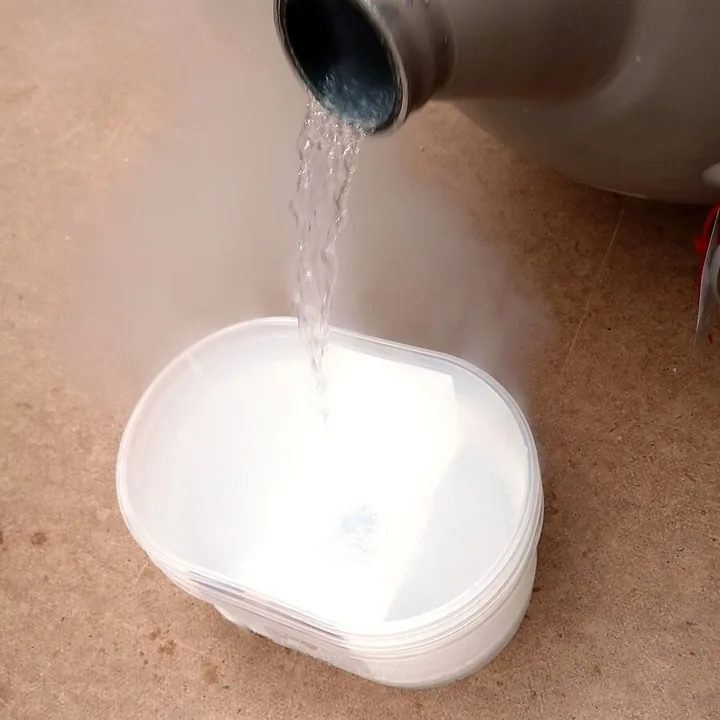
Safety: Inert and non-toxic, but it can push out oxygen in an enclosed room; liquid nitrogen causes severe cold burns.
8Isotopes
Two stable isotopes, nitrogen-14 (99.6%) and nitrogen-15 (0.4%), used as a tracer in agriculture and ecology. Nitrogen-13, radioactive (half-life about 10 minutes), is used in medical imaging.
Isotopes found in nature and their abundance (CIAAW data)
9Its neighbours in the table
Elements in the same column often have similar chemistry; those in the same row have the same number of electron shells.