Carbon
Carbone · C · 6
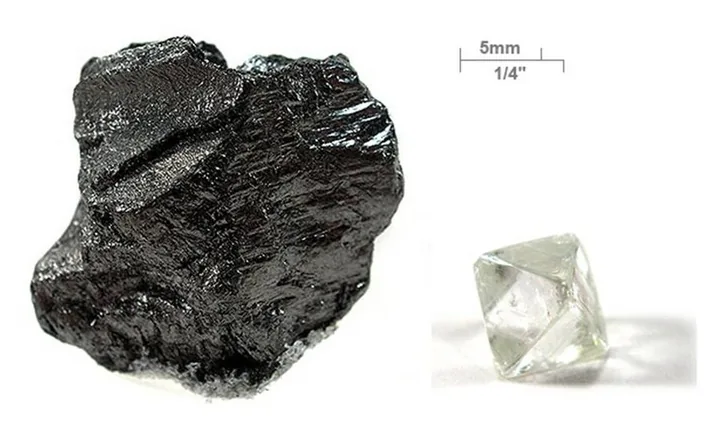
The element of life: every molecule in living things is built around it. Black and soft as graphite, clear and extremely hard as diamond, it forms millions of different compounds.
1Identity card
- Atomic number
- 6protons in the nucleus
- Symbol
- C
- Atomic weight
- 12.011 uIUPAC standard value
- Family
- Other non-metals
- Group · period · block
- 14 · 2 · p
- State at 20 °C
- solid
- Melting point
- —
- Boiling point
- 3,825 °Csublimation: the solid turns straight into gas
- Density
- 2.27 g/cm³graphite; diamond: 3.51
- Electronegativity
- 2.55Pauling scale
- Electron configuration
- [He] 2s2 2p2
- Electrons per shell
- 2 · 4
- Earth’s crust
- 200 g per tonne
- Discovery
- Known since prehistoric times
2The carbon atom
An atom of carbon has 6 protons in its nucleus and, when neutral, as many electrons, spread over 2 shells.
3Discovery
Charcoal has been used since prehistoric times: some drawings in the Chauvet Cave, more than 30,000 years old, are traced in charcoal. Diamond has been known in India since antiquity.
Yet it took until the 18th century to realise that these materials are made of the same element. In 1772 Antoine Lavoisier showed that a burning diamond gives off the same gas as charcoal, “fixed air” (carbon dioxide). In 1796 Smithson Tennant proved that diamond is nothing but pure carbon; Lavoisier had already listed carbon among the elements in 1789.
Want to know more about Lavoisier and other scientists? Visit Les inventeurs, a sister site devoted to scientists and their inventions (in French).
4Origin of the name
From the Latin carbo, “charcoal”.
5Where is it found?
Carbon is the fourth most abundant element in the Universe by mass; it is forged in the cores of stars that fuse helium. On Earth it constantly circulates between the air (carbon dioxide), the oceans, limestone rocks, living things and fossil fuels.
It makes up about a fifth of the mass of the human body: it is the backbone of our proteins, fats, sugars and DNA.
6Uses
7Did you know?
A pencil “lead” has never contained lead: it is graphite mixed with clay.
In 2004 Andre Geim and Konstantin Novoselov isolated graphene, a sheet of carbon one atom thick, using… sticky tape. They won the Nobel Prize in Physics in 2010.
Fullerenes, discovered in 1985, are molecules of 60 carbon atoms shaped like a football.
8Isotopes
Two stable isotopes. Carbon-12 (about 98.9%) is the reference for the atomic mass unit; carbon-13 makes up the rest. Carbon-14, radioactive (half-life about 5,700 years), forms constantly in the atmosphere and is used to date organic remains up to about 50,000 years old.
Isotopes found in nature and their abundance (CIAAW data)
9Its neighbours in the table
Elements in the same column often have similar chemistry; those in the same row have the same number of electron shells.