Boron
Bore · B · 5
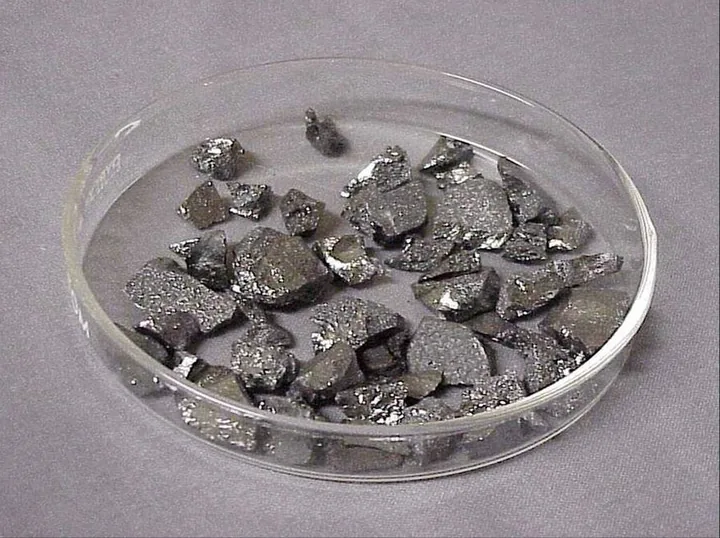
A black, shiny and very hard metalloid. Essential for plants, it makes glass heat-resistant and goes into the most powerful magnets in the world.
1Identity card
- Atomic number
- 5protons in the nucleus
- Symbol
- B
- Atomic weight
- 10.81 uIUPAC standard value
- Family
- Metalloids
- Group · period · block
- 13 · 2 · p
- State at 20 °C
- solid
- Melting point
- 2,076 °C
- Boiling point
- 3,927 °C
- Density
- 2.34 g/cm³at 20 °C
- Electronegativity
- 2.04Pauling scale
- Electron configuration
- [He] 2s2 2p1
- Electrons per shell
- 2 · 3
- Earth’s crust
- 10 g per tonne
- Discovery
- 1808Joseph Louis Gay-Lussac, Louis Jacques Thénard, Humphry Davy
- Place
- Paris (France) and London (England)
2The boron atom
An atom of boron has 5 protons in its nucleus and, when neutral, as many electrons, spread over 2 shells.
3Discovery
Borax, a boron salt, had been used for centuries by goldsmiths to solder precious metals and by glassmakers. In 1808 Joseph Louis Gay-Lussac and Louis Jacques Thénard in Paris, and Humphry Davy in London, each obtained impure boron by heating boric acid with potassium.
Truly pure boron, which is hard to prepare, was only obtained in the early 20th century, notably by the American Ezekiel Weintraub in 1909.
Want to know more about Davy, Gay-Lussac and other scientists? Visit Les inventeurs, a sister site devoted to scientists and their inventions (in French).
4Origin of the name
From borax, a word that came from the Arabic bawraq and the Persian bōrah for this white salt. The English ending -on echoes carbon, which boron resembles in some ways.
5Where is it found?
Boron is never found free in nature. It is extracted from minerals such as borax, kernite and colemanite, laid down in ancient dried-up lakes, mainly in Turkey (the world’s leading producer) and California.
It is rare in the Universe: stars destroy more of it than they make, and most of it is created when cosmic rays shatter carbon or oxygen nuclei in space.
6Uses
7Did you know?
The gooey toy called “slime” is often held together by borax, which links up the long molecules of the glue.
Boron is almost absent from stars: most of the boron atoms in the Universe were made by cosmic rays.
8Isotopes
Two stable isotopes, boron-11 (about 80%) and boron-10 (about 20%), an excellent neutron absorber.
Isotopes found in nature and their abundance (CIAAW data)
9Its neighbours in the table
Elements in the same column often have similar chemistry; those in the same row have the same number of electron shells.