Aluminium
Aluminium · Al · 13
The most abundant metal in the Earth’s crust: light, corrosion-resistant and easy to recycle. Once more precious than gold, it has become the metal of drink cans, aircraft and window frames.
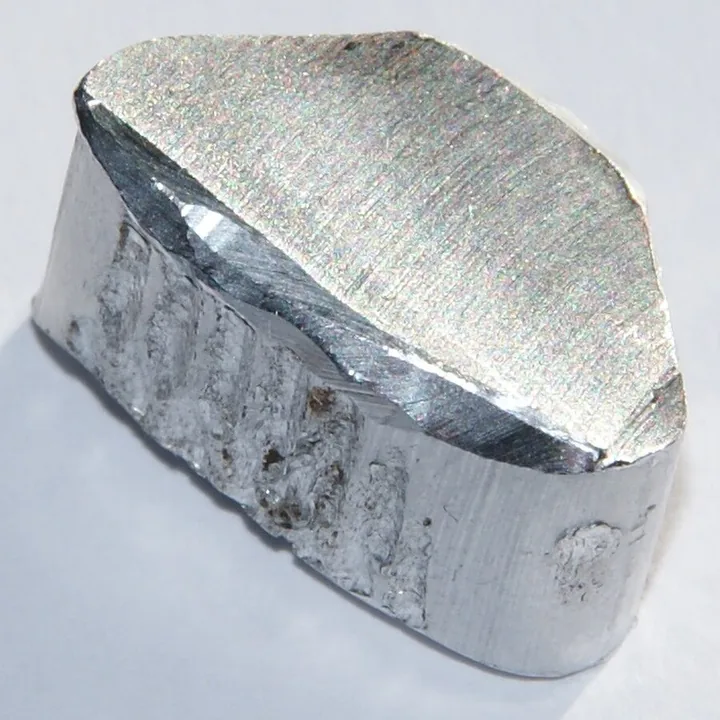
1Identity card
- Atomic number
- 13protons in the nucleus
- Symbol
- Al
- Atomic weight
- 26.982 uIUPAC standard value : 26.9815384
- Family
- Post-transition metals
- Group · period · block
- 13 · 3 · p
- State at 20 °C
- solid
- Melting point
- 660.32 °C
- Boiling point
- 2,519 °C
- Density
- 2.7 g/cm³at 20 °C
- Electronegativity
- 1.61Pauling scale
- Electron configuration
- [Ne] 3s2 3p1
- Electrons per shell
- 2 · 8 · 3
- Earth’s crust
- 8.2 %
- Discovery
- 1825Hans Christian Ørsted; Friedrich Wöhler (1827)
- Place
- Copenhagen (Denmark) and Berlin (Germany)
2The aluminium atom
An atom of aluminium has 13 protons in its nucleus and, when neutral, as many electrons, spread over 3 shells.
3Discovery
Alum, an aluminium salt, was used in antiquity to fix dyes. In the early 19th century Humphry Davy guessed it contained an unknown metal, which he named without being able to isolate it. The Dane Hans Christian Ørsted obtained a little impure metal in Copenhagen in 1825, then the German Friedrich Wöhler a powder in 1827.
In 1854 Henri Sainte-Claire Deville devised a chemical production process, but the metal remained very expensive. Everything changed in 1886, when the American Charles Martin Hall and the Frenchman Paul Héroult independently invented the electrolysis process still used today.
Want to know more about Davy, Ørsted, Wöhler and other scientists? Visit Les inventeurs, a sister site devoted to scientists and their inventions (in French).
4Origin of the name
From the Latin alumen, “alum”. Davy hesitated between several forms; “aluminum” won in the United States and “aluminium” in the rest of the world.
5Where is it found?
The third most abundant element in the Earth’s crust (about 8%) after oxygen and silicon, aluminium never occurs as a metal in nature. It is extracted from bauxite, named after the village of Les Baux-de-Provence in France, where it was described in 1821; Australia, Guinea and China are the main producers.
It is also present in clays, feldspars and many gemstones.
6Uses
- Transport: aircraft, trains, cars and bicycles, thanks to its lightness.
- Packaging: drink cans, kitchen foil, lids.
- Buildings: windows, cladding, roofing.
- Electrical cables for high-voltage power lines.
- Cookware and radiators.
7Did you know?
Under Napoleon III aluminium was so expensive that guests of honour were given aluminium cutlery, while the others had to make do with silver or gold.
In 1884 the top of the Washington Monument in the United States was capped with a small aluminium pyramid: at the time it was a rare and prestigious metal.
Recycling a can takes about twenty times less energy than producing the same aluminium from bauxite.
Ruby and sapphire are crystals of aluminium oxide (corundum), coloured by traces of chromium, iron or titanium.
8Isotopes
One stable isotope, aluminium-27. Aluminium-26, radioactive (half-life about 700,000 years), found in some meteorites, helped heat up the very first bodies of the Solar System.
Isotopes found in nature and their abundance (CIAAW data)
9Its neighbours in the table
Elements in the same column often have similar chemistry; those in the same row have the same number of electron shells.