Magnesium
Magnésium · Mg · 12
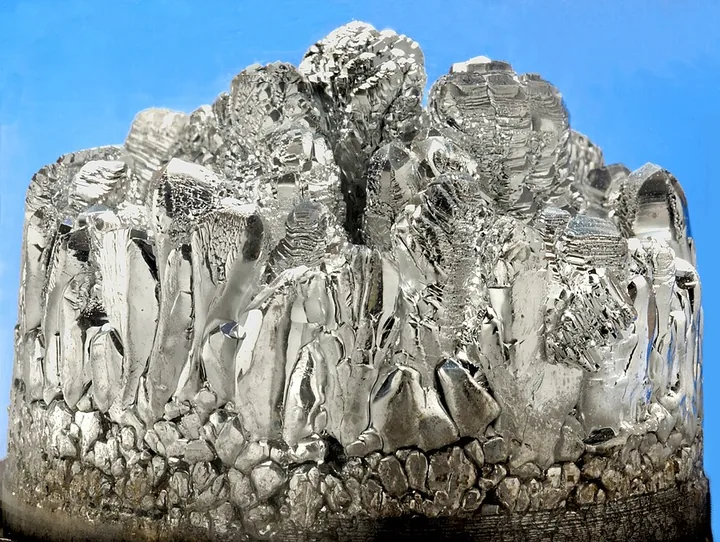
A light, silvery metal that burns with a blinding white light. It sits at the heart of the chlorophyll in plants, in seawater and in the alloys of aircraft and laptops.
1Identity card
- Atomic number
- 12protons in the nucleus
- Symbol
- Mg
- Atomic weight
- 24.305 uIUPAC standard value
- Family
- Alkaline earth metals
- Group · period · block
- 2 · 3 · s
- State at 20 °C
- solid
- Melting point
- 650 °C
- Boiling point
- 1,090 °C
- Density
- 1.738 g/cm³at 20 °C
- Electronegativity
- 1.31Pauling scale
- Electron configuration
- [Ne] 3s2
- Electrons per shell
- 2 · 8 · 2
- Earth’s crust
- 2.3 %
- Discovery
- 1755Joseph Black (identified); Humphry Davy (isolated in 1808)
- Place
- Edinburgh (Scotland) and London (England)
2The magnesium atom
An atom of magnesium has 12 protons in its nucleus and, when neutral, as many electrons, spread over 3 shells.
3Discovery
In 1618 a farmer in Epsom, England, noticed that his cows refused to drink from a bitter spring: from it came “Epsom salt”, a magnesium sulfate. In 1755, in Edinburgh, Joseph Black showed that “white magnesia” was a different substance from lime.
Humphry Davy obtained a little impure magnesium by electrolysis in 1808, and the Frenchman Antoine Bussy prepared enough of the metal in 1831 to describe its properties.
Want to know more about Davy and other scientists? Visit Les inventeurs, a sister site devoted to scientists and their inventions (in French).
4Origin of the name
From Magnesia, a region of Thessaly in Greece that gave its name to several minerals called “magnesia”. Manganese and the magnet (magnes in Latin) share the same origin.
5Where is it found?
The eighth most abundant element in the Earth’s crust, magnesium is found in dolomite, magnesite, talc and olivine. Seawater is an almost inexhaustible source.
The human body contains about 25 grams, more than half of it in bones; it takes part in hundreds of chemical reactions in our cells.
6Uses
- Light alloys for cars, aircraft and laptop cases.
- An ingredient of aluminium alloys, such as those in drink cans.
- Fireworks, signal flares and, in the past, photographers’ flashes.
- Sacrificial anodes that protect ship hulls and water heaters from rust.
- Dietary supplements and antacid medicines.
7Did you know?
A magnesium fire cannot be put out with water, which actually feeds it: it has to be smothered with dry sand.
Every molecule of chlorophyll, the green pigment in leaves, has a magnesium atom at its centre.
Safety: The metal in powder or shavings ignites easily and burns at a very high temperature.
8Isotopes
Three stable isotopes, magnesium-24 (about 79%), magnesium-26 (11%) and magnesium-25 (10%).
Isotopes found in nature and their abundance (CIAAW data)
9Its neighbours in the table
Elements in the same column often have similar chemistry; those in the same row have the same number of electron shells.