Calcium
Calcium · Ca · 20
A silvery-grey alkaline earth metal, the fifth most abundant element in the Earth’s crust. In limestone, chalk and marble it builds landscapes; in our bones and teeth it builds our skeleton.
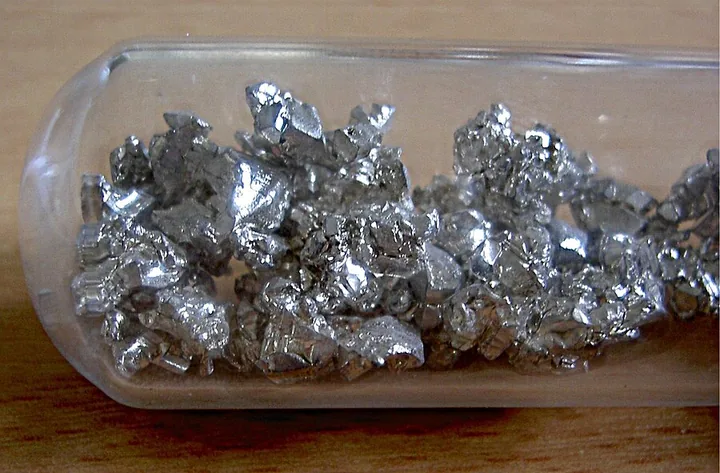
1Identity card
- Atomic number
- 20protons in the nucleus
- Symbol
- Ca
- Atomic weight
- 40.078 uIUPAC standard value
- Family
- Alkaline earth metals
- Group · period · block
- 2 · 4 · s
- State at 20 °C
- solid
- Melting point
- 842 °C
- Boiling point
- 1,484 °C
- Density
- 1.55 g/cm³at 20 °C
- Electronegativity
- 1Pauling scale
- Electron configuration
- [Ar] 4s2
- Electrons per shell
- 2 · 8 · 8 · 2
- Earth’s crust
- 4.2 %
- Discovery
- 1808Humphry Davy
- Place
- London (England)
2The calcium atom
An atom of calcium has 20 protons in its nucleus and, when neutral, as many electrons, spread over 4 shells.
3Discovery
Calcium compounds have been used since antiquity: the Romans made lime by heating limestone to prepare their mortar, and plaster was known to the Egyptians.
The metal itself long defeated chemists. In 1808, in London, Humphry Davy obtained it by electrolysing a mixture of lime and mercury oxide, as an alloy with mercury, which he then drove off by heating.
Want to know more about Davy and other scientists? Visit Les inventeurs, a sister site devoted to scientists and their inventions (in French).
4Origin of the name
From the Latin calx, calcis, “lime”.
5Where is it found?
Calcium makes up about 4% of the Earth’s crust. It is found in limestone, chalk and marble (calcium carbonate), gypsum, fluorite and apatite. Shells, corals and the skeletons of tiny sea creatures are made of calcium carbonate.
It is the most abundant metal in the human body, which contains about one kilogram, almost all of it in bones and teeth.
6Uses
- Cement, lime and plaster, made from limestone and gypsum.
- Steelmaking: lime purifies steel by capturing its impurities.
- Dietary supplements and fortified foods.
- School chalk and white fillers for paper and paint.
7Did you know?
The White Cliffs of Dover and the cliffs of Étretat are made of chalk: the piled-up skeletons of microscopic algae from almost 100 million years ago.
In the 19th century a block of lime heated with a torch lit theatre stages with a brilliant glow, hence the expression “in the limelight”.
Limestone dissolved in hard water comes back as limescale in kettles, and as stalactites in caves.
8Isotopes
Calcium-40 makes up nearly 97% of natural calcium. Calcium-48, rare (0.2%), lives so long that it is considered practically stable; beams of it were used to create the superheavy elements 114 to 118.
Isotopes found in nature and their abundance (CIAAW data)
9Emission spectrum
As a gas or vapour, when heated or crossed by an electric current, calcium atoms give off light at a few very precise wavelengths: these are their lines, a true barcode of the element. Several elements were discovered by observing such lines in a spectroscope.
For listening, each light frequency is divided by 2⁴⁰: the light is transposed down forty octaves, which keeps the exact ratios between the lines. Point to or tap a line to hear it alone.
10Its neighbours in the table
Elements in the same column often have similar chemistry; those in the same row have the same number of electron shells.