Strontium
Strontium · Sr · 38
A silvery alkaline earth metal that colours flames bright red. It gives fireworks and distress flares their red, and it ticks inside the most precise clocks in the world.
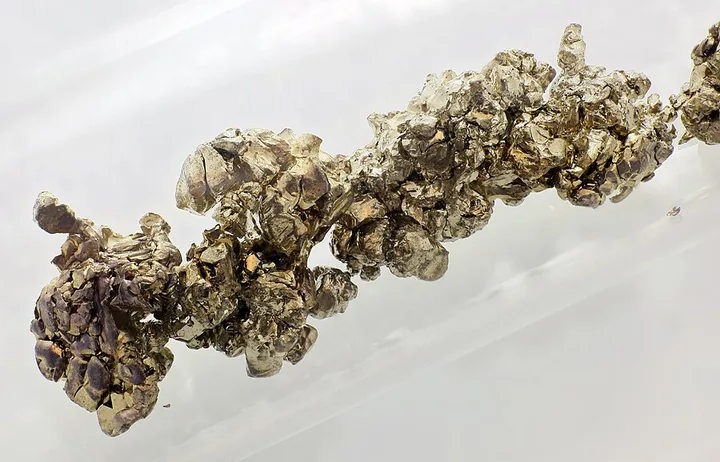
1Identity card
- Atomic number
- 38protons in the nucleus
- Symbol
- Sr
- Atomic weight
- 87.62 uIUPAC standard value
- Family
- Alkaline earth metals
- Group · period · block
- 2 · 5 · s
- State at 20 °C
- solid
- Melting point
- 777 °C
- Boiling point
- 1,377 °C
- Density
- 2.64 g/cm³at 20 °C
- Electronegativity
- 0.95Pauling scale
- Electron configuration
- [Kr] 5s2
- Electrons per shell
- 2 · 8 · 18 · 8 · 2
- Earth’s crust
- 370 g per tonne
- Discovery
- 1790Adair Crawford, William Cruickshank; Humphry Davy (isolated in 1808)
- Place
- Edinburgh (Scotland) and London (England)
2The strontium atom
An atom of strontium has 38 protons in its nucleus and, when neutral, as many electrons, spread over 5 shells.
3Discovery
In 1790 Adair Crawford and William Cruickshank studied a mineral from the lead mines of Strontian, a village in the Scottish Highlands, and realised it contained an unknown “earth”. Thomas Charles Hope, in Edinburgh, confirmed the discovery and noticed the beautiful red flame of its salts.
Humphry Davy isolated the metal in 1808, in London, by electrolysis.
Want to know more about Davy and other scientists? Visit Les inventeurs, a sister site devoted to scientists and their inventions (in French).
4Origin of the name
From the village of Strontian in Scotland, where the mineral strontianite came from.
5Where is it found?
It is extracted mainly from celestine (strontium sulfate) in Spain, China and Mexico. It readily takes the place of calcium in rocks, shells and bones.
6Uses
- Red fireworks and distress flares.
- Strontium ferrite magnets, such as fridge magnets and loudspeaker magnets.
- Glow-in-the-dark paints and objects (strontium aluminate).
- Toothpastes for sensitive teeth.
7Did you know?
In the 1950s and 1960s, strontium-90 from atmospheric nuclear tests turned up in children’s baby teeth. Studies of these teeth helped bring about the Partial Test Ban Treaty of 1963.
Strontium optical clocks would not drift by a second in several billion years.
8Isotopes
Four stable isotopes; strontium-88 makes up about 83%. Strontium-90, radioactive (half-life 28.8 years), is a feared fission product because it settles in bones.
Isotopes found in nature and their abundance (CIAAW data)
9Emission spectrum
As a gas or vapour, when heated or crossed by an electric current, strontium atoms give off light at a few very precise wavelengths: these are their lines, a true barcode of the element. Several elements were discovered by observing such lines in a spectroscope.
For listening, each light frequency is divided by 2⁴⁰: the light is transposed down forty octaves, which keeps the exact ratios between the lines. Point to or tap a line to hear it alone.
10Its neighbours in the table
Elements in the same column often have similar chemistry; those in the same row have the same number of electron shells.