Caesium
Césium · Cs · 55
A pale-golden alkali metal so soft that it melts in an overheated room, at 28.5 °C, and explodes on contact with water. Its atoms define the official second for the whole world.
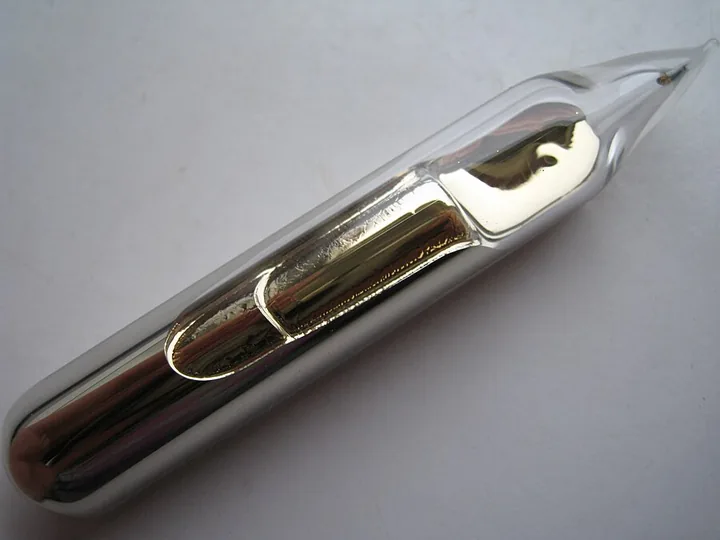
1Identity card
- Atomic number
- 55protons in the nucleus
- Symbol
- Cs
- Atomic weight
- 132.91 uIUPAC standard value : 132.90545196
- Family
- Alkali metals
- Group · period · block
- 1 · 6 · s
- State at 20 °C
- solid
- Melting point
- 28.5 °C
- Boiling point
- 671 °C
- Density
- 1.93 g/cm³at 20 °C
- Electronegativity
- 0.79Pauling scale
- Electron configuration
- [Xe] 6s1
- Electrons per shell
- 2 · 8 · 18 · 18 · 8 · 1
- Earth’s crust
- 3.0 g per tonne
- Discovery
- 1860Robert Bunsen, Gustav Kirchhoff
- Place
- Heidelberg (Germany)
2The caesium atom
An atom of caesium has 55 protons in its nucleus and, when neutral, as many electrons, spread over 6 shells.
3Discovery
In 1860, in Heidelberg, Robert Bunsen and Gustav Kirchhoff evaporated some 40,000 litres of mineral water from Dürkheim. The residue, examined with the spectroscope they had just invented, showed two unknown blue lines.
It was the first element discovered by spectroscopy. The pure metal was only obtained in 1882, by Carl Setterberg.
Want to know more about Bunsen, Kirchhoff and other scientists? Visit Les inventeurs, a sister site devoted to scientists and their inventions (in French).
4Origin of the name
From the Latin caesius, “sky blue”, the colour of its spectral lines. IUPAC spells it caesium; in the United States it is cesium.
5Where is it found?
Caesium is rare; its main source is pollucite, mined notably in Canada (Manitoba).
6Uses
- Atomic clocks: since 1967 the second has been defined by a vibration of caesium-133 atoms.
- Very dense drilling fluids for oil and gas wells (caesium formate).
- Photoelectric cells and physics research.
7Did you know?
One second is exactly 9,192,631,770 oscillations of a radiation emitted by the caesium-133 atom.
Caesium-137, released in the Chernobyl (1986) and Fukushima (2011) accidents, still contaminates some soils.
Safety: Reacts explosively with water and ignites in air.
8Isotopes
One stable isotope, caesium-133. Caesium-137 (half-life 30 years) is a fission product used in industrial gauges and feared in nuclear accidents.
Isotopes found in nature and their abundance (CIAAW data)
9Emission spectrum
As a gas or vapour, when heated or crossed by an electric current, caesium atoms give off light at a few very precise wavelengths: these are their lines, a true barcode of the element. Several elements were discovered by observing such lines in a spectroscope.
For listening, each light frequency is divided by 2⁴⁰: the light is transposed down forty octaves, which keeps the exact ratios between the lines. Point to or tap a line to hear it alone.
10Its neighbours in the table
Elements in the same column often have similar chemistry; those in the same row have the same number of electron shells.