Radium
Radium · Ra · 88
A white, intensely radioactive alkaline earth metal that gives off a faint blue glow in the dark. Its discovery by the Curies opened the age of radioactivity, and of its dangers.
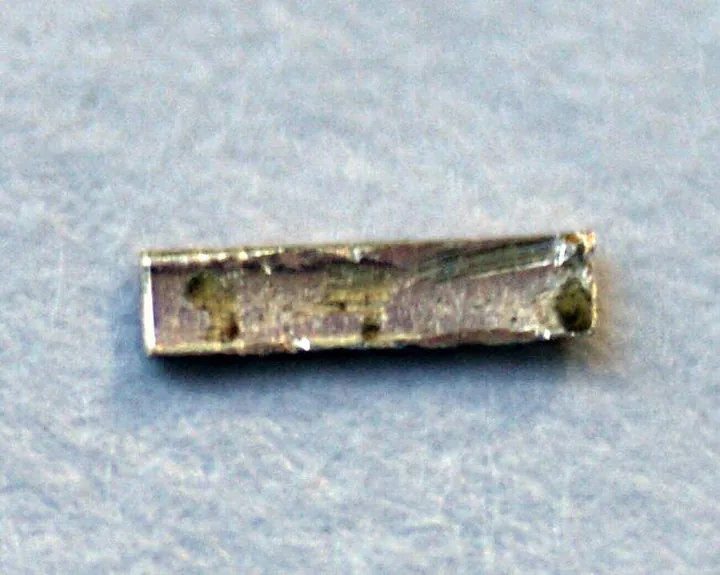
1Identity card
- Atomic number
- 88protons in the nucleus
- Symbol
- Ra
- Atomic weight
- [226]mass number of the most stable known isotope
- Family
- Alkaline earth metals
- Group · period · block
- 2 · 7 · s
- State at 20 °C
- solid
- Melting point
- 696 °C
- Boiling point
- 1,737 °C estimated value
- Density
- 5.5 g/cm³at 20 °C
- Electronegativity
- 0.9Pauling scale
- Electron configuration
- [Rn] 7s2
- Electrons per shell
- 2 · 8 · 18 · 32 · 18 · 8 · 2
- Earth’s crust
- minute traces
- Discovery
- 1898Marie Curie, Pierre Curie, Gustave Bémont
- Place
- Paris (France)
2The radium atom
An atom of radium has 88 protons in its nucleus and, when neutral, as many electrons, spread over 7 shells.
3Discovery
On 26 December 1898, in Paris, Marie Curie, Pierre Curie and Gustave Bémont announced a second new element hidden in pitchblende, even more radioactive than polonium. To obtain a tenth of a gram of its chloride, Marie Curie processed several tonnes of ore residues for almost four years in a poorly heated shed.
In 1910 Marie Curie and André-Louis Debierne isolated metallic radium.
Want to know more about Curie and other scientists? Visit Les inventeurs, a sister site devoted to scientists and their inventions (in French).
4Origin of the name
From the Latin radius, “ray”, because of the radiation it gives off.
5Where is it found?
Radium is constantly formed by the decay of uranium; ores contain about a third of a gram per tonne of uranium.
6Uses
- Today, radium-223 treats bone metastases of some prostate cancers.
- In the past, luminous paint for watch dials, and radium therapy.
7Did you know?
In the 1910s and 1920s, American women who painted watch dials with radium shaped their brushes with their lips; many fell seriously ill. Their fight improved workers’ protection.
The “curie” unit, long used to measure radioactivity, corresponds to the activity of one gram of radium-226.
Marie Curie’s laboratory notebooks are still radioactive; they are consulted with precautions.
Safety: Highly radioactive and radiotoxic.
8Isotopes
No stable isotope. Radium-226, the longest-lived (half-life 1,600 years), belongs to the uranium-238 family.
9Its neighbours in the table
Elements in the same column often have similar chemistry; those in the same row have the same number of electron shells.