Actinium
Actinium · Ac · 89
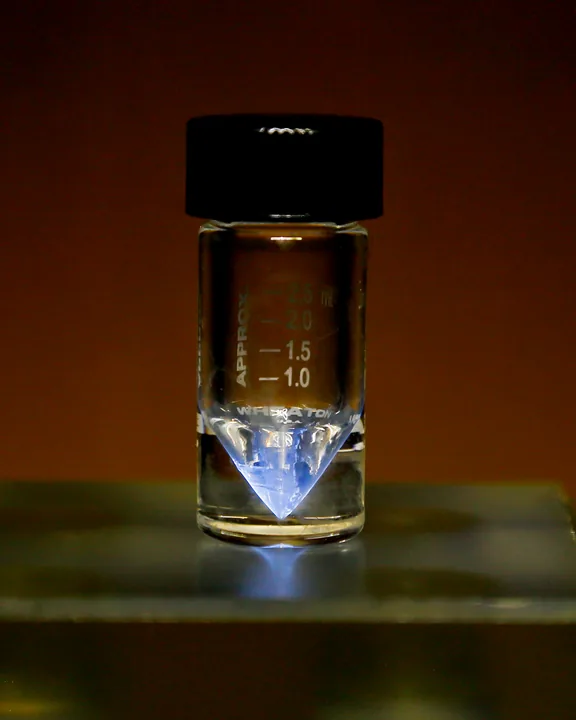
A radioactive silvery metal that gives off a pale blue glow in the dark. It gave its name to the whole actinide family.
1Identity card
- Atomic number
- 89protons in the nucleus
- Symbol
- Ac
- Atomic weight
- [227]mass number of the most stable known isotope
- Family
- Actinides
- Group · period · block
- — (actinides) · 7 · f
- State at 20 °C
- solid
- Melting point
- 1,050 °C
- Boiling point
- 3,198 °C
- Density
- 10.07 g/cm³at 20 °C
- Electronegativity
- 1.1Pauling scale
- Electron configuration
- [Rn] 6d1 7s2
- Electrons per shell
- 2 · 8 · 18 · 32 · 18 · 9 · 2
- Earth’s crust
- minute traces
- Discovery
- 1899André-Louis Debierne (and Friedrich Oskar Giesel in 1902)
- Place
- Paris (France)
2The actinium atom
An atom of actinium has 89 protons in its nucleus and, when neutral, as many electrons, spread over 7 shells.
3Discovery
In 1899, in Paris, André-Louis Debierne, a colleague of the Curies, discovered a new radioactive element in pitchblende residues. The German Friedrich Oskar Giesel found it independently in 1902; Debierne’s priority has been debated, but the name he chose was kept.
4Origin of the name
From the Greek aktis, aktinos, “ray”, like radium.
5Where is it found?
Actinium exists in minute traces in uranium ores. It is produced by irradiating radium in reactors.
6Uses
- Actinium-225, a promising way to destroy cancer cells with alpha particles.
- Neutron sources and research.
7Did you know?
Its radioactivity is so intense that it makes the air around it glow bluish.
Safety: Highly radioactive.
8Isotopes
No stable isotope. The longest-lived, actinium-227, has a half-life of 21.8 years.
9Its neighbours in the table
Elements in the same column often have similar chemistry; those in the same row have the same number of electron shells.