Lanthanum
Lanthane · La · 57
The first of the lanthanides, a soft, silvery metal that tarnishes quickly in air. It improves camera lenses and stores hydrogen in the batteries of hybrid cars.
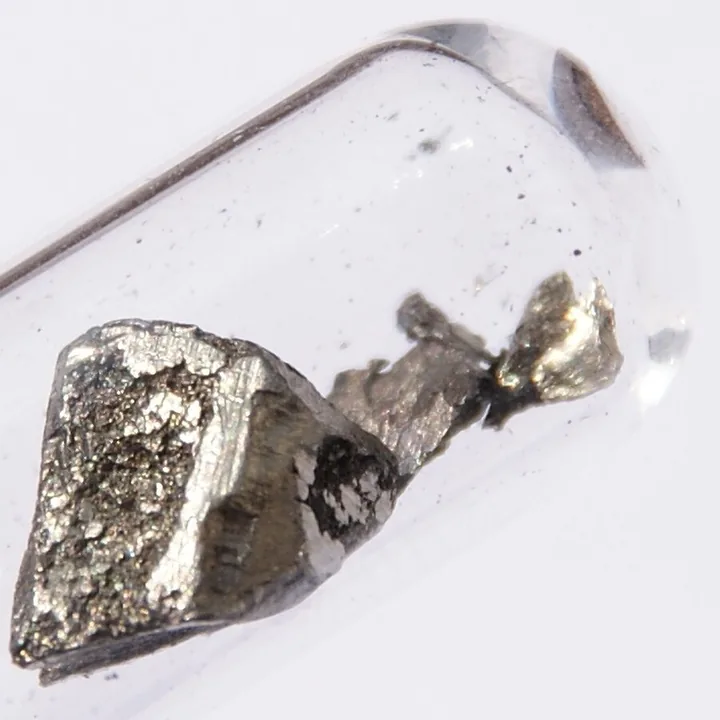
1Identity card
- Atomic number
- 57protons in the nucleus
- Symbol
- La
- Atomic weight
- 138.91 uIUPAC standard value : 138.90547
- Family
- Lanthanides
- Group · period · block
- — (lanthanides) · 6 · f
- State at 20 °C
- solid
- Melting point
- 920 °C
- Boiling point
- 3,464 °C
- Density
- 6.15 g/cm³at 20 °C
- Electronegativity
- 1.1Pauling scale
- Electron configuration
- [Xe] 5d1 6s2
- Electrons per shell
- 2 · 8 · 18 · 18 · 9 · 2
- Earth’s crust
- 39 g per tonne
- Discovery
- 1839Carl Gustaf Mosander
- Place
- Stockholm (Sweden)
2The lanthanum atom
An atom of lanthanum has 57 protons in its nucleus and, when neutral, as many electrons, spread over 6 shells.
3Discovery
In 1839, in Stockholm, Carl Gustaf Mosander, a pupil of Berzelius, decomposed cerium nitrate and found that it contained a hidden “earth”, which he named lanthana. Reasonably pure metal was not obtained until 1923.
Want to know more about Berzelius and other scientists? Visit Les inventeurs, a sister site devoted to scientists and their inventions (in French).
4Origin of the name
From the Greek lanthanein, “to lie hidden”, because it was concealed in cerium compounds.
5Where is it found?
Like the other rare earths, it is extracted from bastnäsite and monazite, mainly in China. Despite the name “rare earths”, it is more abundant in the Earth’s crust than lead.
6Uses
- High-index optical glass for camera and telescope lenses.
- Electrodes in the nickel–metal hydride batteries of hybrid cars.
- Oil-refining catalysts.
- A medicine that limits phosphorus absorption in kidney patients.
7Did you know?
The battery of a hybrid car from the 2000s could contain around ten kilograms of lanthanum.
8Isotopes
Lanthanum-139 makes up 99.9% of natural lanthanum; lanthanum-138, very rare, is weakly radioactive.
Isotopes found in nature and their abundance (CIAAW data)
9Its neighbours in the table
Elements in the same column often have similar chemistry; those in the same row have the same number of electron shells.