Barium
Baryum · Ba · 56
A silvery, reactive alkaline earth metal. Its sulfate, very dense and insoluble, lets doctors see the digestive tract on X-rays and weighs down the drilling mud of oil wells.
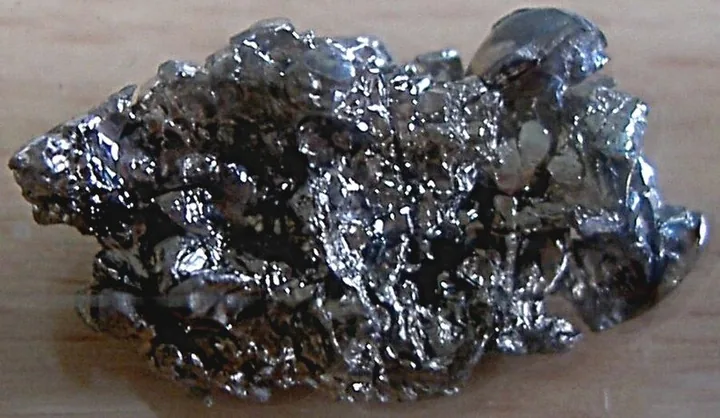
1Identity card
- Atomic number
- 56protons in the nucleus
- Symbol
- Ba
- Atomic weight
- 137.33 uIUPAC standard value : 137.327
- Family
- Alkaline earth metals
- Group · period · block
- 2 · 6 · s
- State at 20 °C
- solid
- Melting point
- 727 °C
- Boiling point
- 1,845 °C
- Density
- 3.51 g/cm³at 20 °C
- Electronegativity
- 0.89Pauling scale
- Electron configuration
- [Xe] 6s2
- Electrons per shell
- 2 · 8 · 18 · 18 · 8 · 2
- Earth’s crust
- 420 g per tonne
- Discovery
- 1774Carl Wilhelm Scheele; Humphry Davy (isolated in 1808)
- Place
- Sweden and London (England)
2The barium atom
An atom of barium has 56 protons in its nucleus and, when neutral, as many electrons, spread over 6 shells.
3Discovery
In the early 17th century, in Bologna, the shoemaker and alchemist Vincenzo Casciarolo heated a heavy pebble (baryte) and found that it glowed in the dark: the famous “Bologna stone”.
In 1774, in Sweden, Carl Wilhelm Scheele showed that baryte contained a new “earth”, different from lime. Humphry Davy isolated the metal in 1808, by electrolysis.
Want to know more about Davy, Scheele and other scientists? Visit Les inventeurs, a sister site devoted to scientists and their inventions (in French).
4Origin of the name
From the Greek barys, “heavy”, because baryte, its ore, is a surprisingly heavy stone.
5Where is it found?
Barium is extracted from baryte (barium sulfate), mainly in China, India and Morocco.
6Uses
- Drilling mud for oil and gas wells, weighted with baryte (the main use).
- X-ray examinations of the digestive tract (“barium meal”).
- Green fireworks.
- Special glasses, ceramics and white pigment.
7Did you know?
The barium sulfate swallowed for an X-ray is harmless because it does not dissolve; other, soluble barium compounds are toxic.
Safety: Soluble barium compounds are toxic.
8Isotopes
Seven natural isotopes; barium-138 makes up more than 70%.
Isotopes found in nature and their abundance (CIAAW data)
9Emission spectrum
As a gas or vapour, when heated or crossed by an electric current, barium atoms give off light at a few very precise wavelengths: these are their lines, a true barcode of the element. Several elements were discovered by observing such lines in a spectroscope.
For listening, each light frequency is divided by 2⁴⁰: the light is transposed down forty octaves, which keeps the exact ratios between the lines. Point to or tap a line to hear it alone.
10Its neighbours in the table
Elements in the same column often have similar chemistry; those in the same row have the same number of electron shells.