Rubidium
Rubidium · Rb · 37
A soft, silvery alkali metal that melts at 39 °C and catches fire spontaneously in air. It keeps time in the atomic clocks carried by navigation satellites.
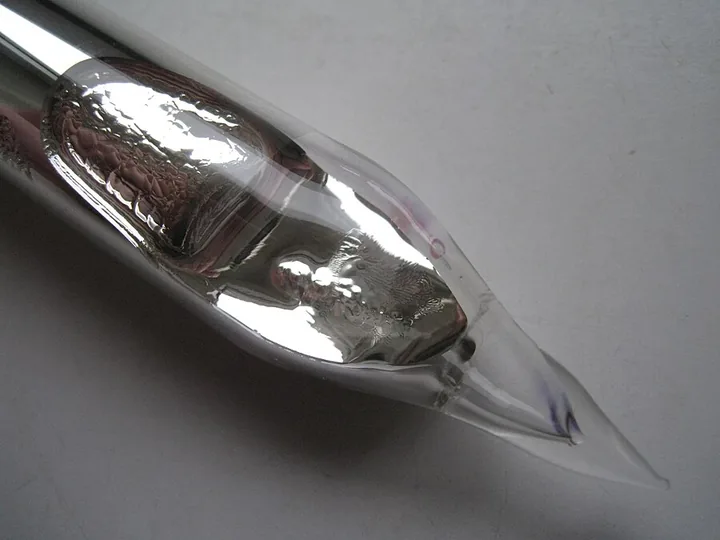
1Identity card
- Atomic number
- 37protons in the nucleus
- Symbol
- Rb
- Atomic weight
- 85.468 uIUPAC standard value : 85.4678
- Family
- Alkali metals
- Group · period · block
- 1 · 5 · s
- State at 20 °C
- solid
- Melting point
- 39.3 °C
- Boiling point
- 688 °C
- Density
- 1.532 g/cm³at 20 °C
- Electronegativity
- 0.82Pauling scale
- Electron configuration
- [Kr] 5s1
- Electrons per shell
- 2 · 8 · 18 · 8 · 1
- Earth’s crust
- 90 g per tonne
- Discovery
- 1861Robert Bunsen, Gustav Kirchhoff
- Place
- Heidelberg (Germany)
2The rubidium atom
An atom of rubidium has 37 protons in its nucleus and, when neutral, as many electrons, spread over 5 shells.
3Discovery
In 1861, in Heidelberg, Robert Bunsen and Gustav Kirchhoff, who had just invented spectroscopy, analysed the light given off by a mineral, lepidolite, heated in a flame. They saw two dark red lines that no known element produced.
It was the second element discovered with the spectroscope, a year after caesium. Bunsen managed to isolate the metal in 1863.
Want to know more about Bunsen, Kirchhoff and other scientists? Visit Les inventeurs, a sister site devoted to scientists and their inventions (in French).
4Origin of the name
From the Latin rubidus, “deep red”, the colour of the lines that revealed it.
5Where is it found?
Rubidium is more abundant in the Earth’s crust than copper or zinc, but it is widely scattered. It is mostly recovered as a by-product of lithium and caesium ores such as lepidolite and pollucite.
6Uses
- Compact atomic clocks, notably aboard GPS and Galileo satellites.
- Physics research: laser cooling of atoms.
- Photoelectric cells and some purple fireworks.
7Did you know?
In 1995 the first Bose–Einstein condensate, a state of matter in which thousands of atoms behave as one, was made with rubidium atoms cooled to a few billionths of a degree above absolute zero.
Safety: Ignites spontaneously in air and reacts violently with water.
8Isotopes
Rubidium-85 (about 72%) is stable; rubidium-87 (about 28%) is very weakly radioactive, with a half-life of 49 billion years, and is used to date the oldest rocks.
Isotopes found in nature and their abundance (CIAAW data)
9Emission spectrum
As a gas or vapour, when heated or crossed by an electric current, rubidium atoms give off light at a few very precise wavelengths: these are their lines, a true barcode of the element. Several elements were discovered by observing such lines in a spectroscope.
For listening, each light frequency is divided by 2⁴⁰: the light is transposed down forty octaves, which keeps the exact ratios between the lines. Point to or tap a line to hear it alone.
10Its neighbours in the table
Elements in the same column often have similar chemistry; those in the same row have the same number of electron shells.