Krypton
Krypton · Kr · 36
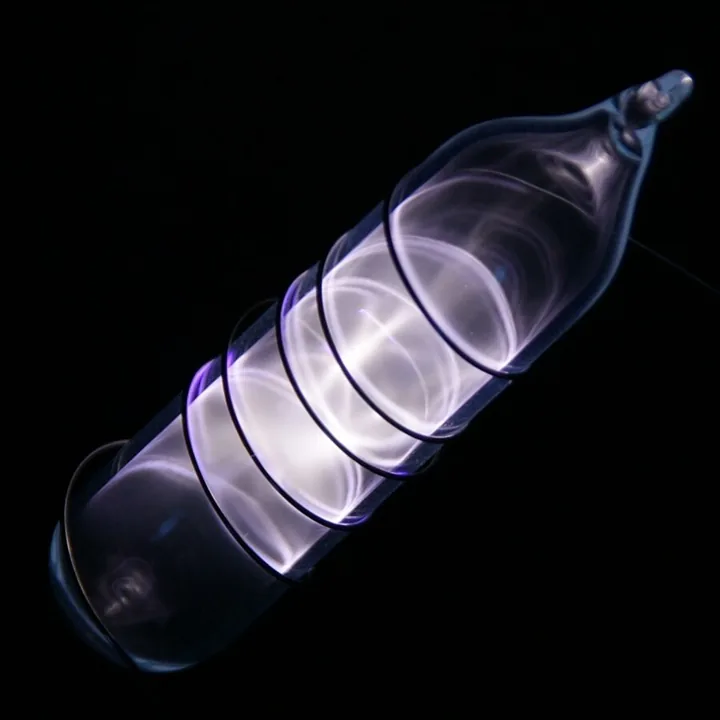
A rare, colourless and odourless noble gas that glows a slightly violet white in an electric tube. Its light was once used to define the length of the metre.
1Identity card
- Atomic number
- 36protons in the nucleus
- Symbol
- Kr
- Atomic weight
- 83.798 uIUPAC standard value
- Family
- Noble gases
- Group · period · block
- 18 · 4 · p
- State at 20 °C
- gas
- Melting point
- −157.37 °C
- Boiling point
- −153.42 °C
- Density
- 3.749 g/Lgas, at 0 °C and 1 atm
- Electronegativity
- 3Pauling scale
- Electron configuration
- [Ar] 3d10 4s2 4p6
- Electrons per shell
- 2 · 8 · 18 · 8
- Earth’s crust
- minute traces
- Discovery
- 1898William Ramsay, Morris Travers
- Place
- London (England)
2The krypton atom
An atom of krypton has 36 protons in its nucleus and, when neutral, as many electrons, spread over 4 shells.
3Discovery
On 30 May 1898, in London, William Ramsay and Morris Travers let a sample of liquid air evaporate almost completely and examined what remained at the bottom. Through the spectroscope, the residue showed yellow and green lines never seen before: a new gas, the first of three they would discover that year, before neon and xenon.
Want to know more about Ramsay and other scientists? Visit Les inventeurs, a sister site devoted to scientists and their inventions (in French).
4Origin of the name
From the Greek kryptos, “hidden”, because it was hiding in the air.
5Where is it found?
Air contains about one part per million of krypton. It is obtained by distilling liquid air, which makes it expensive. A little krypton also forms in nuclear reactors through the fission of uranium.
6Uses
- High-performance lighting: some photographic flash lamps and runway lights.
- Insulating triple-glazed windows, even better than argon.
- Krypton fluoride lasers for patterning microchips.
7Did you know?
From 1960 to 1983 the metre was officially defined as 1,650,763.73 wavelengths of an orange-red line of krypton-86.
Despite its reputation as an inert gas, krypton forms at least one compound, krypton difluoride.
8Isotopes
Six natural isotopes; krypton-84 is the most abundant (about 57%). Krypton-85, radioactive (half-life 10.8 years), is produced by the nuclear industry.
Isotopes found in nature and their abundance (CIAAW data)
9Emission spectrum
As a gas or vapour, when heated or crossed by an electric current, krypton atoms give off light at a few very precise wavelengths: these are their lines, a true barcode of the element. Several elements were discovered by observing such lines in a spectroscope.
For listening, each light frequency is divided by 2⁴⁰: the light is transposed down forty octaves, which keeps the exact ratios between the lines. Point to or tap a line to hear it alone.
10Its neighbours in the table
Elements in the same column often have similar chemistry; those in the same row have the same number of electron shells.