Chlorine
Chlore · Cl · 17
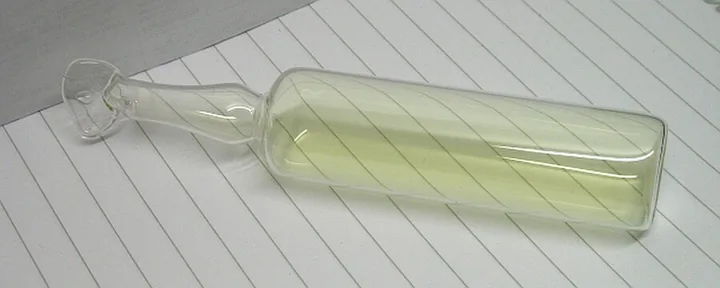
A yellow-green, sharp-smelling and highly toxic gas of the halogen family. Combined with sodium it makes salt; it keeps drinking water safe and is used to make PVC.
1Identity card
- Atomic number
- 17protons in the nucleus
- Symbol
- Cl
- Atomic weight
- 35.45 uIUPAC standard value
- Family
- Halogens
- Group · period · block
- 17 · 3 · p
- State at 20 °C
- gas
- Melting point
- −101.5 °C
- Boiling point
- −34.04 °C
- Density
- 3.214 g/Lgas, at 0 °C and 1 atm
- Electronegativity
- 3.16Pauling scale
- Electron configuration
- [Ne] 3s2 3p5
- Electrons per shell
- 2 · 8 · 7
- Earth’s crust
- 140 g per tonne
- Discovery
- 1774Carl Wilhelm Scheele; Humphry Davy (recognised as an element in 1810)
- Place
- Uppsala (Sweden) and London (England)
2The chlorine atom
An atom of chlorine has 17 protons in its nucleus and, when neutral, as many electrons, spread over 3 shells.
3Discovery
In 1774, in Sweden, Carl Wilhelm Scheele poured “spirit of salt” (hydrochloric acid) onto a manganese ore. He obtained a suffocating yellow-green gas that bleached flowers and paper. He took it to be a compound containing oxygen.
For more than thirty years chemists shared this mistake. In 1810 Humphry Davy proved in London that it was an element and gave it its name.
Want to know more about Davy, Scheele and other scientists? Visit Les inventeurs, a sister site devoted to scientists and their inventions (in French).
4Origin of the name
From the Greek khlōros, “pale green, yellow-green”, the colour of the gas.
5Where is it found?
Chlorine is too reactive to exist free. It occurs mainly as chlorides, dissolved in seawater (nearly 2% of its mass) or laid down in rock-salt deposits.
The human body contains almost 100 grams of chloride; the stomach produces hydrochloric acid to digest food.
6Uses
- Disinfecting tap water and swimming pools, which pushed back cholera and typhoid.
- Making PVC (pipes, window frames, cables): its main use.
- Bleach and whitening agents for paper and textiles.
- The pharmaceutical industry and the chemistry of many plastics and solvents.
7Did you know?
In 1847, in Vienna, the doctor Ignaz Semmelweis had doctors wash their hands in a chlorine solution: deaths among new mothers fell dramatically.
On 22 April 1915, near Ypres in Belgium, the German army released a cloud of chlorine over the trenches: it was the first large gas attack in history, which would lead to the banning of chemical weapons.
Safety: Highly toxic gas. Never mix bleach with other household products (acids, descalers, ammonia): this releases dangerous gases.
8Isotopes
Two stable isotopes, chlorine-35 (about 76%) and chlorine-37 (about 24%), which explains its atomic weight of 35.45. Radioactive chlorine-36 is used to date very old groundwater.
Isotopes found in nature and their abundance (CIAAW data)
9Its neighbours in the table
Elements in the same column often have similar chemistry; those in the same row have the same number of electron shells.