Selenium
Sélénium · Se · 34
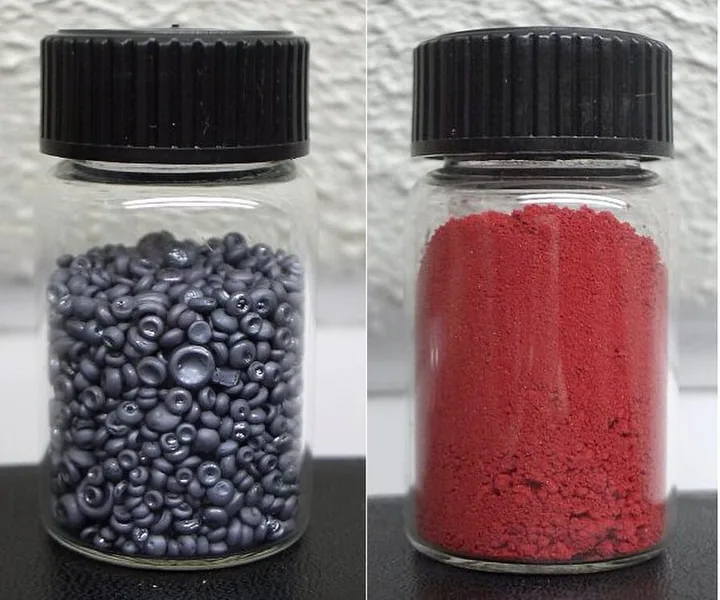
A non-metal that comes in grey, red or black forms and is sensitive to light. Essential to the body in tiny amounts but toxic in excess, it played a key role in the invention of photocopiers.
1Identity card
- Atomic number
- 34protons in the nucleus
- Symbol
- Se
- Atomic weight
- 78.971 uIUPAC standard value
- Family
- Other non-metals
- Group · period · block
- 16 · 4 · p
- State at 20 °C
- solid
- Melting point
- 221 °C
- Boiling point
- 685 °C
- Density
- 4.81 g/cm³at 20 °C
- Electronegativity
- 2.55Pauling scale
- Electron configuration
- [Ar] 3d10 4s2 4p4
- Electrons per shell
- 2 · 8 · 18 · 6
- Earth’s crust
- 50 mg per tonne
- Discovery
- 1817Jöns Jacob Berzelius, Johan Gottlieb Gahn
- Place
- Stockholm (Sweden)
2The selenium atom
An atom of selenium has 34 protons in its nucleus and, when neutral, as many electrons, spread over 4 shells.
3Discovery
In 1817, in Stockholm, Jöns Jacob Berzelius and Johan Gottlieb Gahn examined a reddish deposit at the bottom of the chambers of a sulfuric acid works in which they held shares. They first thought it contained tellurium, then realised it was a new, closely related element.
Want to know more about Berzelius and other scientists? Visit Les inventeurs, a sister site devoted to scientists and their inventions (in French).
4Origin of the name
From the Greek selēnē, “the Moon”: since its neighbour tellurium had been named after the Earth (tellus), Berzelius chose the Moon.
5Where is it found?
Selenium is recovered during the electrolytic refining of copper. Its content in soils varies enormously from one region to another, which can cause deficiencies or poisoning in animals and people. The human body contains about 15 milligrams.
6Uses
7Did you know?
In 1873 the engineer Willoughby Smith discovered that selenium’s electrical resistance drops in light; in 1880 Alexander Graham Bell used this to send a voice along a beam of light.
A single Brazil nut can contain more than the recommended daily intake of selenium.
Safety: Toxic at high doses, as are most of its compounds.
8Isotopes
Six natural isotopes; selenium-80 is the most abundant (about 50%).
Isotopes found in nature and their abundance (CIAAW data)
9Its neighbours in the table
Elements in the same column often have similar chemistry; those in the same row have the same number of electron shells.