Iodine
Iode · I · 53
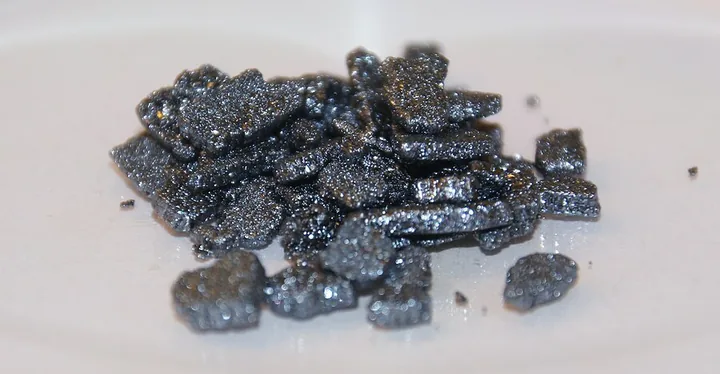
A halogen that forms shiny black crystals and turns straight into a violet vapour when heated. Essential to our thyroid gland, it disinfects wounds and makes blood vessels visible on X-rays.
1Identity card
- Atomic number
- 53protons in the nucleus
- Symbol
- I
- Atomic weight
- 126.90 uIUPAC standard value : 126.90447
- Family
- Halogens
- Group · period · block
- 17 · 5 · p
- State at 20 °C
- solid
- Melting point
- 113.7 °C
- Boiling point
- 184.3 °C
- Density
- 4.93 g/cm³at 20 °C
- Electronegativity
- 2.66Pauling scale
- Electron configuration
- [Kr] 4d10 5s2 5p5
- Electrons per shell
- 2 · 8 · 18 · 18 · 7
- Earth’s crust
- 450 mg per tonne
- Discovery
- 1811Bernard Courtois
- Place
- Paris (France)
2The iodine atom
An atom of iodine has 53 protons in its nucleus and, when neutral, as many electrons, spread over 5 shells.
3Discovery
In 1811, in Paris, Bernard Courtois was making saltpetre from the ash of seaweed (kelp). When he added too much sulfuric acid to his residues, he saw a magnificent violet vapour rise and condense into dark crystals.
Joseph Louis Gay-Lussac and Humphry Davy, who was visiting Paris, showed in 1813 that it was a new element, related to chlorine.
Want to know more about Davy, Gay-Lussac and other scientists? Visit Les inventeurs, a sister site devoted to scientists and their inventions (in French).
4Origin of the name
From the Greek iōdēs, “violet”, the colour of its vapour.
5Where is it found?
Iodine is concentrated by seaweed. Today it is produced mainly from the nitrate deposits of the Atacama Desert in Chile and from brines in Japan. The human body contains about fifteen milligrams, almost all in the thyroid.
6Uses
- Contrast agents for X-rays and CT scans.
- Disinfectants (tincture of iodine, povidone-iodine).
- Iodised table salt, against deficiency.
- Polarising filters in liquid-crystal displays.
- Catalysts and animal feed.
7Did you know?
Lack of iodine causes goitre, a swelling of the thyroid. Adding iodine to salt, from the 1920s in Switzerland and the United States, made the disease almost disappear in many countries.
A drop of iodine on starch (raw potato, flour) turns blue-black: a classic chemists’ test.
Safety: Irritating to the skin, eyes and airways.
8Isotopes
One stable isotope, iodine-127. Iodine-131, radioactive (half-life 8 days), is used to treat some thyroid diseases; released in nuclear accidents, it is the reason stable iodine tablets are handed out.
Isotopes found in nature and their abundance (CIAAW data)
9Its neighbours in the table
Elements in the same column often have similar chemistry; those in the same row have the same number of electron shells.