Bromine
Brome · Br · 35
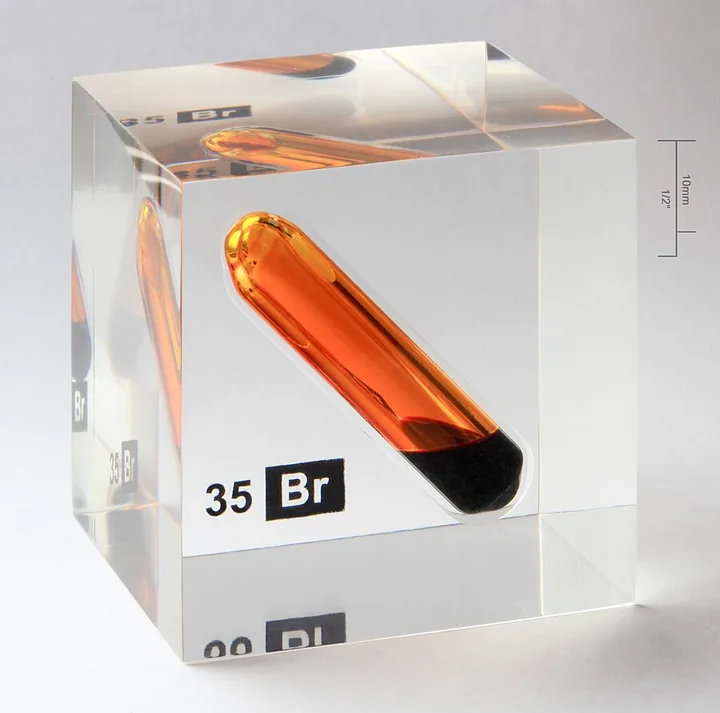
One of only two elements that are liquid at room temperature, along with mercury: a red-brown liquid that gives off choking orange fumes. It hides in seawater and in the Dead Sea.
1Identity card
- Atomic number
- 35protons in the nucleus
- Symbol
- Br
- Atomic weight
- 79.904 uIUPAC standard value
- Family
- Halogens
- Group · period · block
- 17 · 4 · p
- State at 20 °C
- liquid
- Melting point
- −7.2 °C
- Boiling point
- 58.8 °C
- Density
- 3.1028 g/cm³at 20 °C
- Electronegativity
- 2.96Pauling scale
- Electron configuration
- [Ar] 3d10 4s2 4p5
- Electrons per shell
- 2 · 8 · 18 · 7
- Earth’s crust
- 2.4 g per tonne
- Discovery
- 1826Antoine-Jérôme Balard (and Carl Jacob Löwig)
- Place
- Montpellier (France) and Heidelberg (Germany)
2The bromine atom
An atom of bromine has 35 protons in its nucleus and, when neutral, as many electrons, spread over 4 shells.
3Discovery
In 1826, in Montpellier, the 23-year-old Antoine-Jérôme Balard was studying the bitterns of salt marshes, the liquid left after salt crystallises. By bubbling chlorine through it, he obtained a dark red, strong-smelling liquid: a new element.
A year earlier the German student Carl Jacob Löwig had isolated the same substance from spring water, but published too late. The famous chemist Justus von Liebig had once held bromine in his hands and mistaken it for an iodine compound, an error he never forgave himself.
4Origin of the name
From the Greek brōmos, “stench”, because of the irritating smell of its fumes.
5Where is it found?
Seawater contains about 65 milligrams per litre. It is extracted mainly from the highly concentrated brines of the Dead Sea (Israel, Jordan) and from salt wells in the United States and China.
6Uses
- Flame retardants for plastics and textiles (some are now banned).
- Drilling fluids for oil and gas wells.
- Disinfecting water in spas and pools.
- Medicines, dyes and, formerly, silver bromide photographic film.
7Did you know?
Tyrian purple, the violet dye reserved for Roman emperors, is a bromine compound obtained from small sea snails called murex: thousands were needed for a single gram.
Safety: A highly toxic and corrosive liquid whose fumes burn the eyes and lungs.
8Isotopes
Two stable isotopes in almost equal amounts, bromine-79 (50.7%) and bromine-81 (49.3%).
Isotopes found in nature and their abundance (CIAAW data)
9Its neighbours in the table
Elements in the same column often have similar chemistry; those in the same row have the same number of electron shells.