Argon
Argon · Ar · 18
A colourless noble gas, the third component of air, far more abundant than carbon dioxide. Completely inert, it shields metals during welding and fills light bulbs and double glazing.
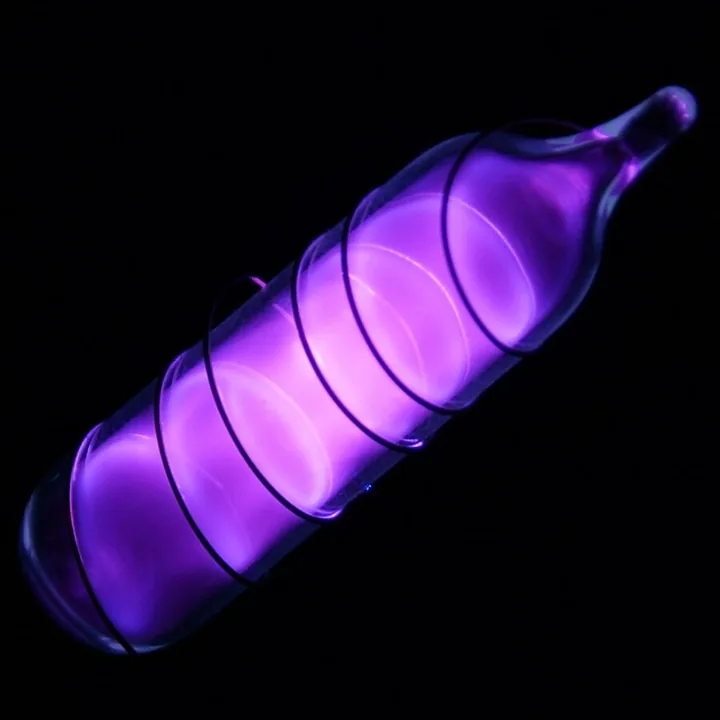
1Identity card
- Atomic number
- 18protons in the nucleus
- Symbol
- Ar
- Atomic weight
- 39.95 uIUPAC standard value
- Family
- Noble gases
- Group · period · block
- 18 · 3 · p
- State at 20 °C
- gas
- Melting point
- −189.34 °C
- Boiling point
- −185.85 °C
- Density
- 1.784 g/Lgas, at 0 °C and 1 atm
- Electronegativity
- not defined
- Electron configuration
- [Ne] 3s2 3p6
- Electrons per shell
- 2 · 8 · 8
- Earth’s crust
- 3.5 g per tonne
- Discovery
- 1894Lord Rayleigh, William Ramsay
- Place
- London (England)
2The argon atom
An atom of argon has 18 protons in its nucleus and, when neutral, as many electrons, spread over 3 shells.
3Discovery
In 1892, in Cambridge, Lord Rayleigh noticed that nitrogen taken from the air was slightly heavier (by about half a percent) than nitrogen made chemically. With William Ramsay, in London, he removed the nitrogen and oxygen from air and was left with an unknown gas that reacted with nothing.
They announced the discovery of argon in 1894. A century earlier, Henry Cavendish had already seen a small bubble of gas that refused to react, without being able to explain it. Rayleigh and Ramsay both received Nobel Prizes in 1904.
Want to know more about Cavendish, Ramsay, Nobel and other scientists? Visit Les inventeurs, a sister site devoted to scientists and their inventions (in French).
4Origin of the name
From the Greek argos, “lazy, idle”, because it reacts with no other substance.
5Where is it found?
Argon makes up nearly 1% of the air (0.93%), more than twenty times as much as carbon dioxide. Almost all of it comes from the decay of radioactive potassium-40 in rocks, built up over billions of years.
It is obtained as a by-product of distilling liquid air.
6Uses
- Shielding gas for welding and for producing titanium and stainless steel.
- Filling incandescent bulbs and fluorescent tubes.
- Insulating double and triple glazing.
- Preservation: wine, historical documents, food.
- Argon lasers with a blue-green beam, used in eye surgery and light shows.
7Did you know?
Potassium–argon dating measures the argon built up in volcanic rocks to find their age, up to billions of years.
The founding documents of the United States, such as the Declaration of Independence, are displayed in cases filled with argon, which protects them from oxygen.
Safety: Not toxic, but it can push out oxygen in an enclosed room and cause suffocation.
8Isotopes
Three stable isotopes, argon-40 (99.6% of the argon in air), argon-36 and argon-38. In stars, argon-36 dominates.
Isotopes found in nature and their abundance (CIAAW data)
9Emission spectrum
As a gas or vapour, when heated or crossed by an electric current, argon atoms give off light at a few very precise wavelengths: these are their lines, a true barcode of the element. Several elements were discovered by observing such lines in a spectroscope.
For listening, each light frequency is divided by 2⁴⁰: the light is transposed down forty octaves, which keeps the exact ratios between the lines. Point to or tap a line to hear it alone.
10Its neighbours in the table
Elements in the same column often have similar chemistry; those in the same row have the same number of electron shells.