Fluorine
Fluor · F · 9
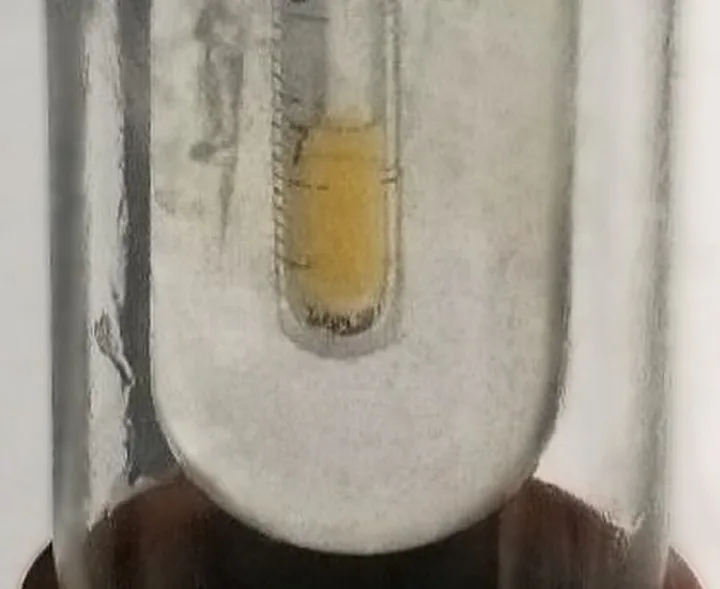
The most reactive element of all, a pale yellow gas that attacks almost everything, even glass. Tamed in stable compounds, it protects our teeth and makes pans non-stick.
1Identity card
- Atomic number
- 9protons in the nucleus
- Symbol
- F
- Atomic weight
- 18.998 uIUPAC standard value : 18.998403162
- Family
- Halogens
- Group · period · block
- 17 · 2 · p
- State at 20 °C
- gas
- Melting point
- −219.67 °C
- Boiling point
- −188.11 °C
- Density
- 1.696 g/Lgas, at 0 °C and 1 atm
- Electronegativity
- 3.98Pauling scale
- Electron configuration
- [He] 2s2 2p5
- Electrons per shell
- 2 · 7
- Earth’s crust
- 580 g per tonne
- Discovery
- 1886Henri Moissan
- Place
- Paris (France)
2The fluorine atom
An atom of fluorine has 9 protons in its nucleus and, when neutral, as many electrons, spread over 2 shells.
3Discovery
Fluorite, a mineral containing fluorine, had been used as a flux in metalworking since the 16th century. In 1771 Carl Wilhelm Scheele prepared hydrofluoric acid, which can etch glass, and in 1810 André-Marie Ampère suggested it contained an element related to chlorine.
Isolating this element proved extremely dangerous: several chemists were badly poisoned and some died. On 26 June 1886, in Paris, Henri Moissan finally succeeded by electrolysing a cooled mixture of hydrofluoric acid and potassium fluoride in a platinum apparatus. The feat earned him the Nobel Prize in Chemistry in 1906.
Want to know more about Scheele, Moissan, Nobel and other scientists? Visit Les inventeurs, a sister site devoted to scientists and their inventions (in French).
4Origin of the name
From fluorite, itself named after the Latin fluere, “to flow”, because the mineral helped metals melt and flow.
5Where is it found?
Too reactive to exist on its own, fluorine is found in minerals such as fluorite (calcium fluoride), fluorapatite and cryolite. The Earth’s crust contains about 0.06%.
In the human body it settles mainly in bones and tooth enamel, which it makes more resistant to decay.
6Uses
- Fluorides in toothpaste, and sometimes in water or salt, to prevent tooth decay.
- Teflon (PTFE): non-stick coatings, seals, cable insulation.
- Refrigerant gases in fridges and air conditioners.
- Electrolytes in lithium-ion batteries and etching of microchips.
- Medicines: a large share of modern drug molecules contain at least one fluorine atom.
7Did you know?
Fluorine is so greedy for electrons that it even reacts with xenon, a noble gas thought to be inert.
The word “fluorescence” comes from fluorite: the physicist George Stokes coined it in 1852 while studying the bluish glow this mineral gives off under ultraviolet light.
Safety: Extremely toxic and corrosive gas; hydrofluoric acid causes deep burns.
8Isotopes
One stable isotope, fluorine-19. Fluorine-18, radioactive (half-life about 110 minutes), is attached to a sugar for the positron emission tomography (PET) scans that locate tumours.
Isotopes found in nature and their abundance (CIAAW data)
9Its neighbours in the table
Elements in the same column often have similar chemistry; those in the same row have the same number of electron shells.