Helium
Hélium · He · 2
A colourless, inert noble gas and the second most abundant element in the Universe. Lighter than air, it makes balloons float; as a liquid, it lets scientists reach temperatures close to absolute zero.
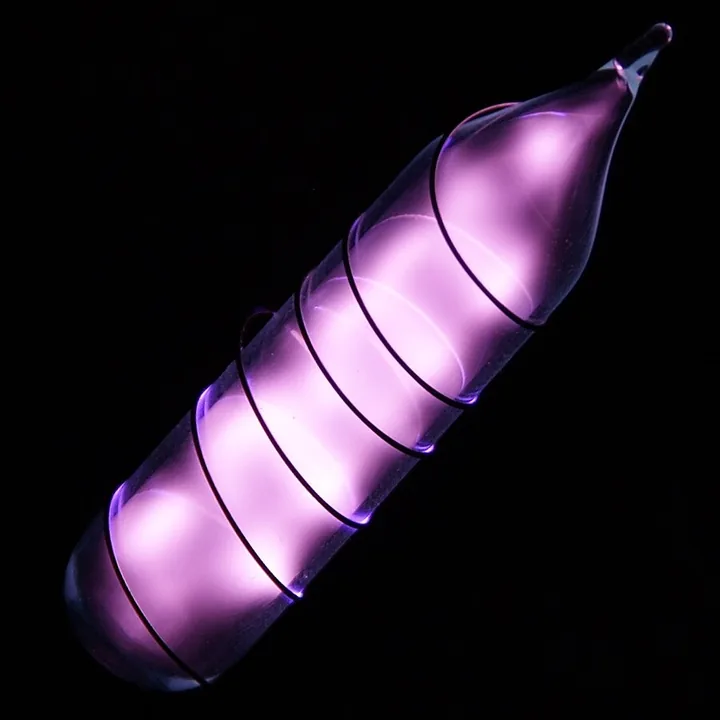
1Identity card
- Atomic number
- 2protons in the nucleus
- Symbol
- He
- Atomic weight
- 4.0026 uIUPAC standard value : 4.002602
- Family
- Noble gases
- Group · period · block
- 18 · 1 · s
- State at 20 °C
- gas
- Melting point
- —does not freeze at ordinary pressure
- Boiling point
- −268.93 °C
- Density
- 0.1786 g/Lgas, at 0 °C and 1 atm
- Electronegativity
- not defined
- Electron configuration
- 1s2
- Electrons per shell
- 2
- Earth’s crust
- 8.0 mg per tonne
- Discovery
- 1868Jules Janssen, Norman Lockyer
- Place
- seen in the Sun’s spectrum (India and England)
2The helium atom
An atom of helium has 2 protons in its nucleus and, when neutral, as many electrons, spread over 1 shell.
3Discovery
Helium was first seen… in the Sun. On 18 August 1868, during a total eclipse observed in India, the French astronomer Jules Janssen spotted an unknown yellow line in the light of the solar prominences. The Englishman Norman Lockyer studied it the same year and concluded that it revealed an element unknown on Earth.
Not until 1895 did William Ramsay, in London, isolate the gas by heating a uranium ore called cleveite. Almost at the same moment, the Swedes Per Teodor Cleve and Nils Abraham Langlet made the same discovery in Uppsala and measured its mass.
Want to know more about Ramsay and other scientists? Visit Les inventeurs, a sister site devoted to scientists and their inventions (in French).
4Origin of the name
From the Greek hēlios, “the Sun”. Lockyer and the chemist Edward Frankland gave it an -ium ending, like a metal, because they knew nothing about its nature.
5Where is it found?
Helium makes up about a quarter of the mass of ordinary matter in the Universe. Most of it was produced in the first minutes after the Big Bang, the rest by stars.
On Earth it is scarce in the air (about 5 parts per million) because, being so light, it eventually escapes into space. It is extracted from natural gas, where it collects after being produced, very slowly, by the decay of uranium and thorium in rocks.
6Uses
- Cooling the superconducting magnets of MRI scanners and large particle accelerators, at around −269 °C.
- Filling party balloons, weather balloons and airships, because it does not burn.
- Shielding gas for welding and for making microchips.
- Breathing mixtures for deep divers, to avoid nitrogen narcosis.
- Leak detection: its tiny atoms slip through the smallest cracks.
7Did you know?
Cooled below −271 °C, liquid helium becomes a superfluid: it flows with no friction at all and can even creep up the walls of its container.
It is the only element that never turns solid at ordinary pressure, even at absolute zero: it has to be squeezed to about 25 times atmospheric pressure.
Sound travels almost three times faster in helium than in air, which is why a voice sounds squeaky after breathing it. It is a dangerous game, because it deprives the body of oxygen.
Safety: Not toxic, but breathing pure helium deprives the body of oxygen and can cause fainting.
8Isotopes
Two stable isotopes. Helium-4 makes up nearly all helium on Earth; helium-3, very rare (a few atoms per million), is prized for ultra-low-temperature physics and neutron detection.
Isotopes found in nature and their abundance (CIAAW data)
9Emission spectrum
As a gas or vapour, when heated or crossed by an electric current, helium atoms give off light at a few very precise wavelengths: these are their lines, a true barcode of the element. Several elements were discovered by observing such lines in a spectroscope.
For listening, each light frequency is divided by 2⁴⁰: the light is transposed down forty octaves, which keeps the exact ratios between the lines. Point to or tap a line to hear it alone.
10Its neighbours in the table
Elements in the same column often have similar chemistry; those in the same row have the same number of electron shells.