Hydrogen
Hydrogène · H · 1
The lightest of all elements and the most common in the Universe. Combined with oxygen it makes water; inside stars it is the fuel that makes them shine.
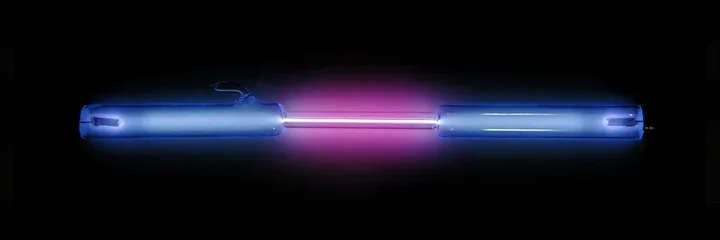
1Identity card
- Atomic number
- 1protons in the nucleus
- Symbol
- H
- Atomic weight
- 1.008 uIUPAC standard value
- Family
- Other non-metals
- Group · period · block
- 1 · 1 · s
- State at 20 °C
- gas
- Melting point
- −259.16 °C
- Boiling point
- −252.87 °C
- Density
- 0.0899 g/Lgas, at 0 °C and 1 atm
- Electronegativity
- 2.2Pauling scale
- Electron configuration
- 1s1
- Electrons per shell
- 1
- Earth’s crust
- 1,400 g per tonne
- Discovery
- 1766Henry Cavendish
- Place
- London (England)
2The hydrogen atom
An atom of hydrogen has 1 proton in its nucleus and, when neutral, as many electrons, spread over 1 shell.
3Discovery
As early as the 16th century, Paracelsus noticed that an “air” bubbled off when iron was attacked by acid, and Robert Boyle collected this gas in 1671 without understanding what it was. Henry Cavendish, working in London in 1766, studied it methodically: he showed that this “inflammable air” was a distinct substance, far lighter than ordinary air. Fifteen years later he found that it produced water when it burned.
In 1783 Antoine Lavoisier repeated the experiment in Paris, drew the decisive conclusion (water is a compound, not an element) and named the gas “hydrogène”.
Want to know more about Lavoisier, Cavendish, Boyle and other scientists? Visit Les inventeurs, a sister site devoted to scientists and their inventions (in French).
4Origin of the name
From the Greek hydōr, “water”, and gennan, “to produce”: hydrogen is literally “the water-maker”. Lavoisier proposed the name in 1783.
5Where is it found?
Hydrogen makes up about three quarters of the mass of ordinary matter in the Universe and more than nine atoms in ten. Stars such as the Sun are mostly hydrogen, which they fuse into helium to produce their energy.
On Earth it is rarely found free: it is locked up in water, in living things, in oil and in natural gas. It accounts for about 10% of the mass of the human body, but almost two atoms out of three.
6Uses
7Did you know?
The first hydrogen balloon, built by the physicist Jacques Charles and the Robert brothers, rose above Paris in 1783, just days after the hot-air Montgolfier balloons.
In 1937 the hydrogen-filled airship Hindenburg caught fire while landing in the United States: the disaster ended the era of large passenger airships.
Under colossal pressure, as in the core of Jupiter, hydrogen is expected to become a liquid metal that conducts electricity.
Safety: Extremely flammable gas; mixed with air it can ignite violently.
8Isotopes
Three isotopes. Protium, with no neutron, makes up almost all hydrogen. Deuterium, with one neutron, is stable and is found in “heavy water”. Tritium, with two neutrons, is radioactive (half-life 12.3 years) and is used in nuclear fusion research.
Isotopes found in nature and their abundance (CIAAW data)
9Emission spectrum
As a gas or vapour, when heated or crossed by an electric current, hydrogen atoms give off light at a few very precise wavelengths: these are their lines, a true barcode of the element. Several elements were discovered by observing such lines in a spectroscope.
For listening, each light frequency is divided by 2⁴⁰: the light is transposed down forty octaves, which keeps the exact ratios between the lines. Point to or tap a line to hear it alone.
10Its neighbours in the table
Elements in the same column often have similar chemistry; those in the same row have the same number of electron shells.