Beryllium
Béryllium · Be · 4
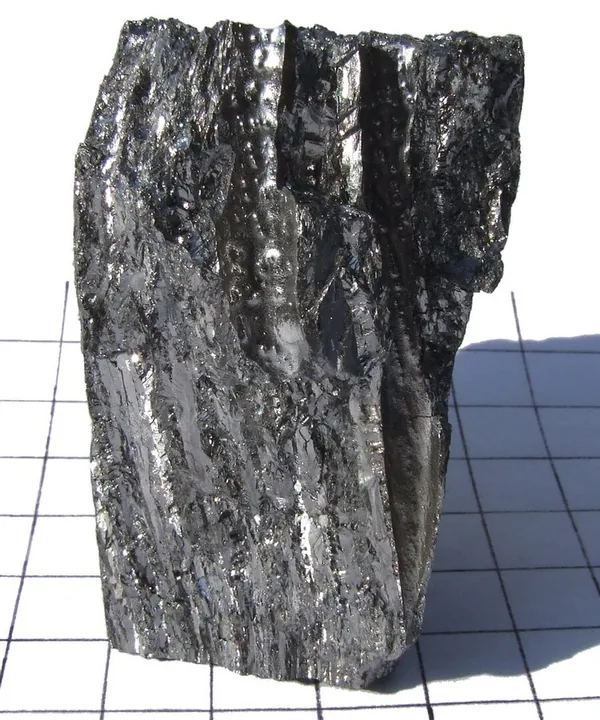
A steel-grey metal, lighter than aluminium yet very stiff, and almost transparent to X-rays. Rare and toxic as dust, it also hides in two gemstones, emerald and aquamarine.
1Identity card
- Atomic number
- 4protons in the nucleus
- Symbol
- Be
- Atomic weight
- 9.0122 uIUPAC standard value : 9.0121831
- Family
- Alkaline earth metals
- Group · period · block
- 2 · 2 · s
- State at 20 °C
- solid
- Melting point
- 1,287 °C
- Boiling point
- 2,469 °C
- Density
- 1.85 g/cm³at 20 °C
- Electronegativity
- 1.57Pauling scale
- Electron configuration
- [He] 2s2
- Electrons per shell
- 2 · 2
- Earth’s crust
- 2.8 g per tonne
- Discovery
- 1798Louis-Nicolas Vauquelin
- Place
- Paris (France)
2The beryllium atom
An atom of beryllium has 4 protons in its nucleus and, when neutral, as many electrons, spread over 2 shells.
3Discovery
In 1798, in Paris, Louis-Nicolas Vauquelin analysed beryl and emerald at the request of the mineralogist René Just Haüy, who suspected they were the same mineral. He found a new “earth” whose salts, he noted, tasted sweet (a test nobody would do today, as they are toxic).
The metal was isolated in 1828, independently, by Friedrich Wöhler in Germany and Antoine Bussy in France, by reacting its chloride with potassium.
Want to know more about Wöhler and other scientists? Visit Les inventeurs, a sister site devoted to scientists and their inventions (in French).
4Origin of the name
From beryl, the mineral it was extracted from (Greek bēryllos). In France it was long called glucinium, from the Greek glukus, “sweet”, because of the taste of its salts.
5Where is it found?
Scarce (about 3 g per tonne of the Earth’s crust), it comes mainly from bertrandite, in the United States, and from beryl.
Beryl is also a gemstone: tinted green by a little chromium or vanadium it becomes emerald; tinted blue by iron, it is aquamarine.
6Uses
- Copper–beryllium alloys, hard and spark-free: tools for mines and refineries, springs, electrical connectors.
- Windows of X-ray tubes and detectors, which it lets through almost without absorbing them.
- Space telescope mirrors and satellite parts, thanks to its lightness and stiffness.
- Precision instruments and fighter-aircraft parts.
7Did you know?
The 18 hexagonal segments of the main mirror of the James Webb Space Telescope, launched in 2021, are beryllium coated with a thin layer of gold: it keeps its shape in the deep cold of space.
In 1932 James Chadwick discovered the neutron by bombarding beryllium with alpha particles.
Safety: Beryllium dust and fumes are highly toxic to the lungs; it is machined under strict protection.
8Isotopes
One stable isotope, beryllium-9. Beryllium-10, radioactive (half-life about 1.4 million years), forms in the atmosphere when cosmic rays strike it and is used to date ice and sediments.
Isotopes found in nature and their abundance (CIAAW data)
9Its neighbours in the table
Elements in the same column often have similar chemistry; those in the same row have the same number of electron shells.