Lithium
Lithium · Li · 3
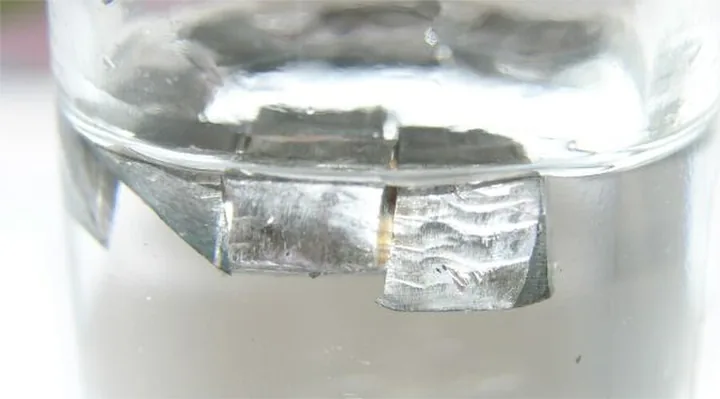
The lightest of all metals, so low in density that it floats on water and even on oil. Soft enough to cut with a knife, it has become essential to the batteries in our phones and electric cars.
1Identity card
- Atomic number
- 3protons in the nucleus
- Symbol
- Li
- Atomic weight
- 6.94 uIUPAC standard value
- Family
- Alkali metals
- Group · period · block
- 1 · 2 · s
- State at 20 °C
- solid
- Melting point
- 180.5 °C
- Boiling point
- 1,342 °C
- Density
- 0.534 g/cm³at 20 °C
- Electronegativity
- 0.98Pauling scale
- Electron configuration
- [He] 2s1
- Electrons per shell
- 2 · 1
- Earth’s crust
- 20 g per tonne
- Discovery
- 1817Johan August Arfwedson
- Place
- Stockholm (Sweden)
2The lithium atom
An atom of lithium has 3 protons in its nucleus and, when neutral, as many electrons, spread over 2 shells.
3Discovery
In 1817, in Stockholm, the young chemist Johan August Arfwedson, working in Jöns Jacob Berzelius’s laboratory, analysed a mineral from the island of Utö called petalite. He found an unknown alkali in it, lighter than soda and potash.
Arfwedson could not isolate the metal. William Thomas Brande and Humphry Davy managed it by electrolysis in 1821, and Robert Bunsen and Augustus Matthiessen produced larger amounts in 1855.
Want to know more about Davy, Bunsen, Berzelius and other scientists? Visit Les inventeurs, a sister site devoted to scientists and their inventions (in French).
4Origin of the name
From the Greek lithos, “stone”: unlike sodium and potassium, known from plant ashes, it was discovered in a mineral.
5Where is it found?
Fairly rare (about 20 g per tonne of the Earth’s crust), lithium is extracted from rocks such as spodumene, mainly in Australia, and from the brines of the great salt flats of South America (Chile, Argentina, Bolivia). Seawater contains a little.
It is one of the three elements formed in the Big Bang, together with hydrogen and helium.
6Uses
- Lithium-ion batteries for phones, laptops and electric vehicles: by far its biggest use today.
- Glass and ceramics that withstand thermal shock, such as glass-ceramic hobs.
- Lubricating greases for bearings and cars.
- Medicine: lithium salts have treated bipolar disorder since 1949.
- Aluminium–lithium alloys, light and stiff, for aircraft.
7Did you know?
In a flame, lithium salts give an intense crimson colour that makes them easy to recognise.
A 10 cm cube of lithium would weigh barely more than half a kilo, half as much as a litre of water.
An American lemon-lime soda launched in 1929 contained lithium citrate, praised for its calming effect; it was removed from the recipe in 1948.
Safety: Reacts with water, releasing flammable hydrogen; it is stored away from moisture.
8Isotopes
Two stable isotopes, lithium-7 (about 95%) and lithium-6 (about 5%).
Isotopes found in nature and their abundance (CIAAW data)
9Emission spectrum
As a gas or vapour, when heated or crossed by an electric current, lithium atoms give off light at a few very precise wavelengths: these are their lines, a true barcode of the element. Several elements were discovered by observing such lines in a spectroscope.
For listening, each light frequency is divided by 2⁴⁰: the light is transposed down forty octaves, which keeps the exact ratios between the lines. Point to or tap a line to hear it alone.
10Its neighbours in the table
Elements in the same column often have similar chemistry; those in the same row have the same number of electron shells.