Sodium
Sodium · Na · 11
A silvery metal so soft it cuts like butter, and so reactive it catches fire in contact with water. Combined with chlorine, though, it becomes table salt, which our bodies cannot do without.
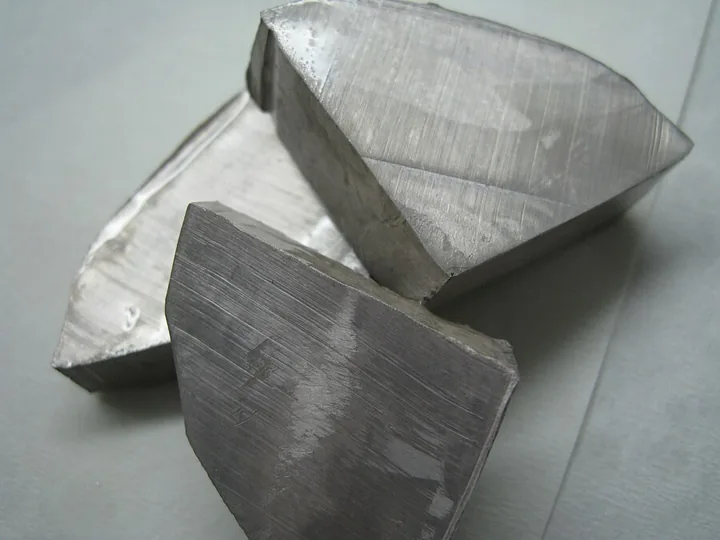
1Identity card
- Atomic number
- 11protons in the nucleus
- Symbol
- Na
- Atomic weight
- 22.990 uIUPAC standard value : 22.98976928
- Family
- Alkali metals
- Group · period · block
- 1 · 3 · s
- State at 20 °C
- solid
- Melting point
- 97.79 °C
- Boiling point
- 882.94 °C
- Density
- 0.968 g/cm³at 20 °C
- Electronegativity
- 0.93Pauling scale
- Electron configuration
- [Ne] 3s1
- Electrons per shell
- 2 · 8 · 1
- Earth’s crust
- 2.4 %
- Discovery
- 1807Humphry Davy
- Place
- London (England)
2The sodium atom
An atom of sodium has 11 protons in its nucleus and, when neutral, as many electrons, spread over 3 shells.
3Discovery
Sodium compounds have been known since antiquity: the Egyptians used natron for mummification, and soda was used to make glass and soap. Nobody knew, however, that they concealed a metal.
In October 1807, in London, Humphry Davy passed a powerful electric current through molten caustic soda. A few days after obtaining potassium the same way, he saw small shiny metal globules appear and burst into flame in the air: sodium.
Want to know more about Davy and other scientists? Visit Les inventeurs, a sister site devoted to scientists and their inventions (in French).
4Origin of the name
From “soda”, a word of uncertain origin, possibly Arabic. The symbol Na comes from the Latin natrium, after natron, the salt of the ancient Egyptians.
5Where is it found?
The sixth most abundant element in the Earth’s crust, sodium is found mainly in rock salt (halite), in feldspars and in seawater, which holds about 30 grams of salt per litre.
The human body contains around a hundred grams: it controls the amount of water in the body and lets nerves transmit their signals.
6Uses
- Sodium chloride: table salt, food preservation, de-icing roads, chemical industry.
- Sodium-vapour lamps with their orange light, long used for street lighting.
- Sodium carbonate for glass, sodium hydroxide for soap and paper, bicarbonate for cooking.
- Liquid sodium to cool some experimental nuclear reactors.
7Did you know?
The yellow-orange colour of a flame when a pinch of salt falls into it comes from sodium: it is the same light as in old street lamps.
In 1814 Joseph von Fraunhofer noticed two dark lines in the yellow part of the Sun’s spectrum; in 1859 they were shown to be caused by sodium in the Sun’s atmosphere.
Safety: Reacts violently with water, releasing hydrogen that can ignite; it is stored under oil.
8Isotopes
One stable isotope, sodium-23. Sodium-22, radioactive (half-life 2.6 years), is used as a positron source in laboratories.
Isotopes found in nature and their abundance (CIAAW data)
9Emission spectrum
As a gas or vapour, when heated or crossed by an electric current, sodium atoms give off light at a few very precise wavelengths: these are their lines, a true barcode of the element. Several elements were discovered by observing such lines in a spectroscope.
For listening, each light frequency is divided by 2⁴⁰: the light is transposed down forty octaves, which keeps the exact ratios between the lines. Point to or tap a line to hear it alone.
10Its neighbours in the table
Elements in the same column often have similar chemistry; those in the same row have the same number of electron shells.