Oxygen
Oxygène · O · 8
The gas that keeps life and fire going. The most abundant element in the Earth’s crust and in the human body, it forms water with hydrogen and most rocks with silicon.
1Identity card
- Atomic number
- 8protons in the nucleus
- Symbol
- O
- Atomic weight
- 15.999 uIUPAC standard value
- Family
- Other non-metals
- Group · period · block
- 16 · 2 · p
- State at 20 °C
- gas
- Melting point
- −218.79 °C
- Boiling point
- −182.96 °C
- Density
- 1.429 g/Lgas, at 0 °C and 1 atm
- Electronegativity
- 3.44Pauling scale
- Electron configuration
- [He] 2s2 2p4
- Electrons per shell
- 2 · 6
- Earth’s crust
- 46.1 %
- Discovery
- 1774Carl Wilhelm Scheele, Joseph Priestley, Antoine Lavoisier
- Place
- Uppsala (Sweden), Calne (England) and Paris (France)
2The oxygen atom
An atom of oxygen has 8 protons in its nucleus and, when neutral, as many electrons, spread over 2 shells.
3Discovery
Oxygen was discovered almost simultaneously by three scientists. Around 1771–1772, in Uppsala, the Swede Carl Wilhelm Scheele obtained “fire air” by heating various compounds, but his book only came out in 1777. On 1 August 1774, in England, Joseph Priestley heated mercury oxide with a large burning lens and collected a gas in which a candle burned brilliantly and a mouse lived longer.
Antoine Lavoisier, in Paris, repeated these experiments and drew a new theory from them: burning means combining with this gas. He named it “oxygène” in 1777 and put an end to the old phlogiston theory.
Want to know more about Lavoisier, Scheele, Priestley and other scientists? Visit Les inventeurs, a sister site devoted to scientists and their inventions (in French).
4Origin of the name
From the Greek oxys, “acid”, and gennan, “to produce”: Lavoisier believed all acids contained oxygen, which turned out to be wrong (hydrochloric acid has none).
5Where is it found?
Oxygen is the most abundant element in the Earth’s crust (about 46% by mass), where it is bound to silicon, aluminium and iron in rocks. It makes up 21% of the air and almost 89% of the mass of water.
It accounts for about 65% of the mass of the human body, mostly as water. In the Universe it is the third most abundant element, forged in the cores of massive stars.
6Uses
7Did you know?
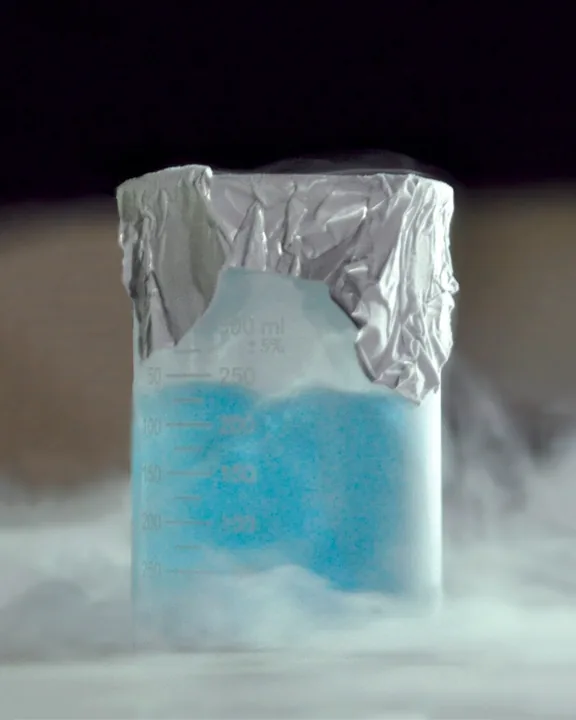
Liquid oxygen is pale blue and magnetic: poured between the poles of a strong magnet, it stays suspended there.
About 2.4 billion years ago, photosynthetic microbes called cyanobacteria began filling the atmosphere with oxygen. This “Great Oxidation Event” changed the whole history of life.
High in the atmosphere, ozone, a molecule of three oxygen atoms, blocks much of the Sun’s ultraviolet radiation.
Safety: Pure oxygen makes fires far more violent: grease and oils can ignite on contact with it.
8Isotopes
Three stable isotopes, oxygen-16 (99.76%), oxygen-18 (0.2%) and oxygen-17 (0.04%). The ratio of oxygen-18 to oxygen-16 in polar ice is used to reconstruct past temperatures.
Isotopes found in nature and their abundance (CIAAW data)
9Its neighbours in the table
Elements in the same column often have similar chemistry; those in the same row have the same number of electron shells.