Xenon
Xénon · Xe · 54
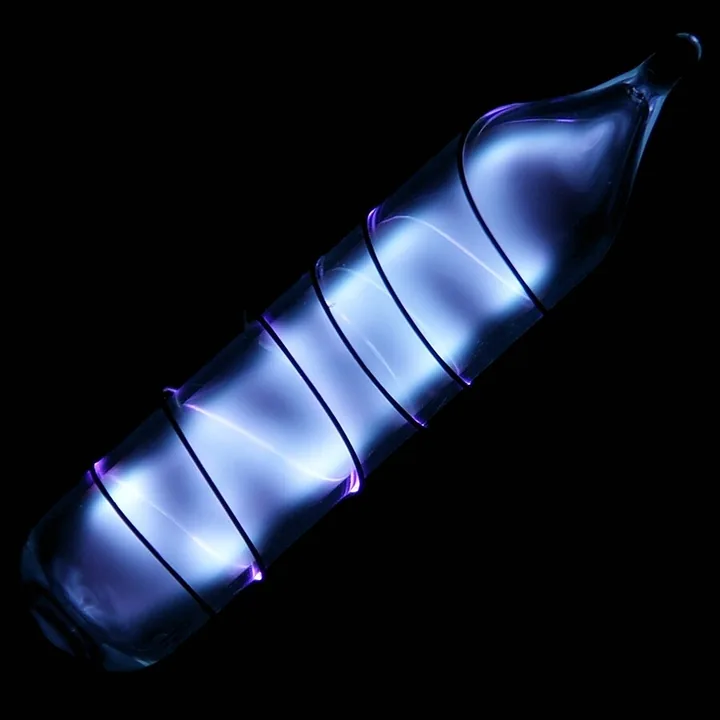
A heavy, rare noble gas that glows with a bluish light in an electric tube. It is found in car headlights, cinema projectors and the ion engines of space probes.
1Identity card
- Atomic number
- 54protons in the nucleus
- Symbol
- Xe
- Atomic weight
- 131.29 uIUPAC standard value : 131.293
- Family
- Noble gases
- Group · period · block
- 18 · 5 · p
- State at 20 °C
- gas
- Melting point
- −111.75 °C
- Boiling point
- −108.1 °C
- Density
- 5.894 g/Lgas, at 0 °C and 1 atm
- Electronegativity
- 2.6Pauling scale
- Electron configuration
- [Kr] 4d10 5s2 5p6
- Electrons per shell
- 2 · 8 · 18 · 18 · 8
- Earth’s crust
- minute traces
- Discovery
- 1898William Ramsay, Morris Travers
- Place
- London (England)
2The xenon atom
An atom of xenon has 54 protons in its nucleus and, when neutral, as many electrons, spread over 5 shells.
3Discovery
On 12 July 1898, in London, William Ramsay and Morris Travers redistilled the liquid-air residue that had given them krypton. They found an even heavier gas in it that glowed a magnificent blue in the tube: xenon, the third and last of their discoveries that year.
Want to know more about Ramsay and other scientists? Visit Les inventeurs, a sister site devoted to scientists and their inventions (in French).
4Origin of the name
From the Greek xenos, “stranger”, because it was hiding among the gases of the air.
5Where is it found?
Xenon makes up only 0.09 parts per million of the air, making it one of the most expensive gases. It is recovered during the distillation of liquid air.
6Uses
- Xenon car headlights and cinema projector lamps.
- Ion engines on satellites and space probes, which expel xenon ions.
- Flash lamps and ultraviolet lamps.
- A general anaesthetic, very well tolerated but costly.
- Dark-matter detectors filled with liquid xenon.
7Did you know?
In 1962, in Vancouver, the chemist Neil Bartlett prepared the first compound of a noble gas, from xenon and a platinum fluoride: so the “inert” gases were not all inert.
8Isotopes
Nine natural isotopes, two of them very weakly radioactive. Xenon-135, produced in nuclear reactors, absorbs huge numbers of neutrons and has to be closely watched by operators.
Isotopes found in nature and their abundance (CIAAW data)
9Its neighbours in the table
Elements in the same column often have similar chemistry; those in the same row have the same number of electron shells.