Cerium
Cérium · Ce · 58
The most abundant rare earth, a grey metal that throws off sparks when scraped. Its oxide polishes spectacle lenses and screens.
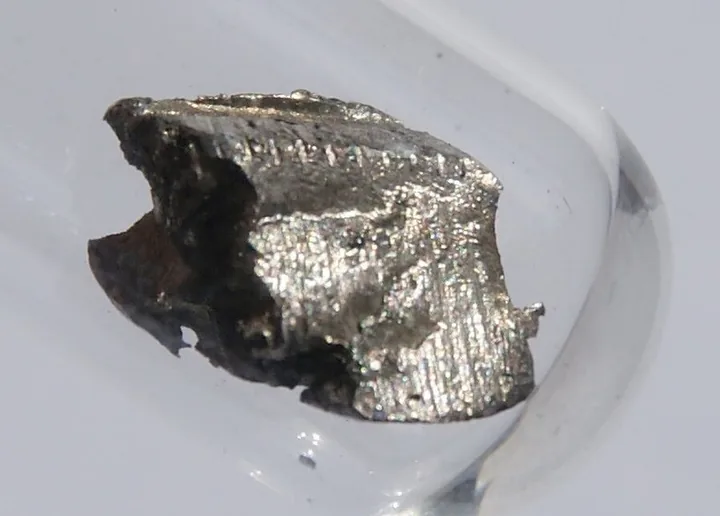
1Identity card
- Atomic number
- 58protons in the nucleus
- Symbol
- Ce
- Atomic weight
- 140.12 uIUPAC standard value : 140.116
- Family
- Lanthanides
- Group · period · block
- — (lanthanides) · 6 · f
- State at 20 °C
- solid
- Melting point
- 795 °C
- Boiling point
- 3,443 °C
- Density
- 6.77 g/cm³at 20 °C
- Electronegativity
- 1.12Pauling scale
- Electron configuration
- [Xe] 4f1 5d1 6s2
- Electrons per shell
- 2 · 8 · 18 · 19 · 9 · 2
- Earth’s crust
- 66 g per tonne
- Discovery
- 1803Jöns Jacob Berzelius, Wilhelm Hisinger; Martin Heinrich Klaproth
- Place
- Sweden and Berlin (Germany)
2The cerium atom
An atom of cerium has 58 protons in its nucleus and, when neutral, as many electrons, spread over 6 shells.
3Discovery
In 1803, in Sweden, Jöns Jacob Berzelius and Wilhelm Hisinger discovered a new “earth” in a mineral from the Bastnäs mine; Martin Heinrich Klaproth made the same discovery in Germany. The metal was isolated in 1875.
Want to know more about Berzelius, Klaproth and other scientists? Visit Les inventeurs, a sister site devoted to scientists and their inventions (in French).
4Origin of the name
From Ceres, the largest body in the asteroid belt, discovered two years earlier, in 1801, and itself named after the Roman goddess of harvests.
5Where is it found?
Cerium is as abundant in the Earth’s crust as copper. It is extracted from bastnäsite and monazite in China, the United States and Australia.
6Uses
- Cerium oxide powder for polishing glass, lenses and screens.
- Catalytic converter catalysts.
- Ferrocerium lighter flints.
- Glass that blocks ultraviolet light.
7Did you know?
A lighter flint is an alloy of iron and cerium: scraping it tears off tiny shavings that ignite spontaneously.
8Isotopes
Four natural isotopes; cerium-140 makes up about 88%.
Isotopes found in nature and their abundance (CIAAW data)
9Its neighbours in the table
Elements in the same column often have similar chemistry; those in the same row have the same number of electron shells.