Praseodymium
Praséodyme · Pr · 59
A silvery lanthanide whose salts are pale green. Together with neodymium it goes into the most powerful magnets and into glassblowers’ safety goggles.
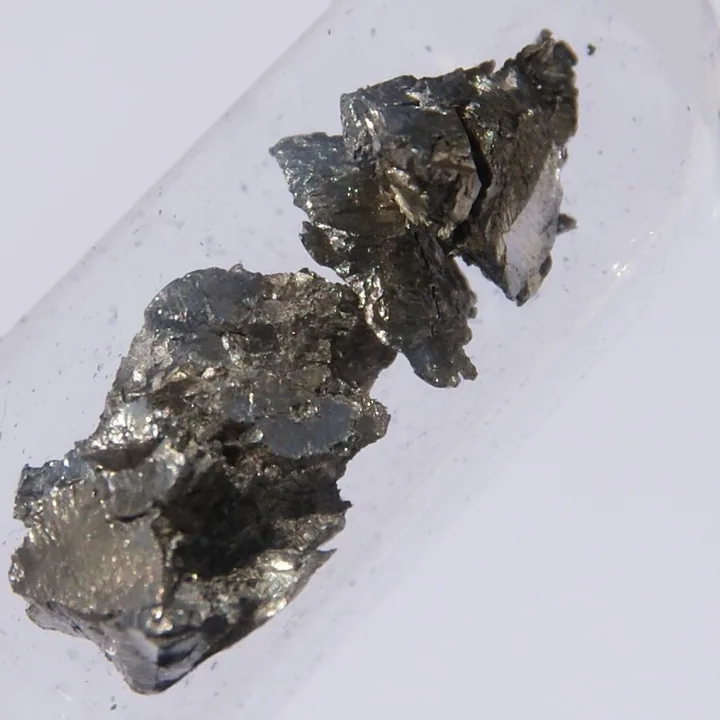
1Identity card
- Atomic number
- 59protons in the nucleus
- Symbol
- Pr
- Atomic weight
- 140.91 uIUPAC standard value : 140.90766
- Family
- Lanthanides
- Group · period · block
- — (lanthanides) · 6 · f
- State at 20 °C
- solid
- Melting point
- 935 °C
- Boiling point
- 3,520 °C
- Density
- 6.77 g/cm³at 20 °C
- Electronegativity
- 1.13Pauling scale
- Electron configuration
- [Xe] 4f3 6s2
- Electrons per shell
- 2 · 8 · 18 · 21 · 8 · 2
- Earth’s crust
- 9.2 g per tonne
- Discovery
- 1885Carl Auer von Welsbach
- Place
- Vienna (Austria)
2The praseodymium atom
An atom of praseodymium has 59 protons in its nucleus and, when neutral, as many electrons, spread over 6 shells.
3Discovery
In 1885, in Vienna, Carl Auer von Welsbach managed to split “didymium”, believed to be an element, into two new elements, praseodymium and neodymium, after hundreds of successive crystallisations.
4Origin of the name
From the Greek prasios, “leek-green”, and didymos, “twin”: neodymium’s “green twin”.
5Where is it found?
It accompanies neodymium in bastnäsite and monazite, mined mainly in China.
6Uses
- Neodymium–praseodymium–iron–boron permanent magnets.
- Protective glasses for welders and glassblowers (“didymium” glass).
- A yellow-green colouring for glass and ceramics.
- Alloys for aircraft engines.
7Did you know?
Didymium, discovered in 1841, appeared in lists of elements for more than forty years before chemists realised it hid two.
8Isotopes
One stable isotope, praseodymium-141.
Isotopes found in nature and their abundance (CIAAW data)
9Its neighbours in the table
Elements in the same column often have similar chemistry; those in the same row have the same number of electron shells.