Uranium
Uranium · U · 92
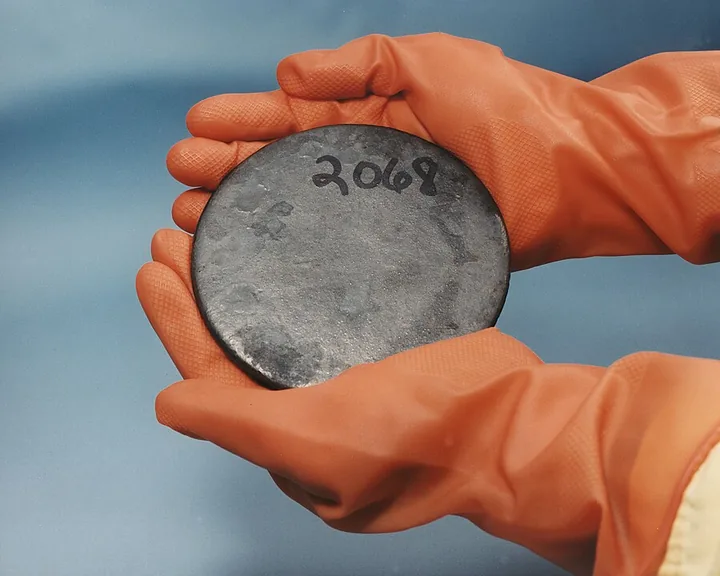
The heaviest element found in quantity in nature, a weakly radioactive silvery-grey metal. It led to the discovery of radioactivity, and then of the nuclear fission that produces electricity in power stations.
1Identity card
- Atomic number
- 92protons in the nucleus
- Symbol
- U
- Atomic weight
- 238.03 uIUPAC standard value : 238.02891
- Family
- Actinides
- Group · period · block
- — (actinides) · 7 · f
- State at 20 °C
- solid
- Melting point
- 1,132.2 °C
- Boiling point
- 4,131 °C
- Density
- 19.1 g/cm³at 20 °C
- Electronegativity
- 1.38Pauling scale
- Electron configuration
- [Rn] 5f3 6d1 7s2
- Electrons per shell
- 2 · 8 · 18 · 32 · 21 · 9 · 2
- Earth’s crust
- 2.7 g per tonne
- Discovery
- 1789Martin Heinrich Klaproth; Eugène-Melchior Péligot (metal isolated in 1841)
- Place
- Berlin (Germany) and Paris (France)
2The uranium atom
An atom of uranium has 92 protons in its nucleus and, when neutral, as many electrons, spread over 7 shells.
3Discovery
In 1789, in Berlin, Martin Heinrich Klaproth analysed pitchblende, a black ore from the silver mines of Joachimsthal in Bohemia. He found the oxide of a new element in it, which he took to be the metal itself. In 1841, in Paris, Eugène-Melchior Péligot isolated true uranium metal.
In 1896 Henri Becquerel discovered in Paris that uranium salts spontaneously emit radiation that can fog a photographic plate: radioactivity. In 1938, in Berlin, Otto Hahn and Fritz Strassmann observed that uranium bombarded with neutrons splits in two; Lise Meitner and Otto Frisch explained the phenomenon, fission.
Want to know more about Becquerel, Klaproth, Meitner and other scientists? Visit Les inventeurs, a sister site devoted to scientists and their inventions (in French).
4Origin of the name
From the planet Uranus, discovered eight years earlier, in 1781, by William Herschel.
5Where is it found?
Uranium is roughly as abundant as tin in the Earth’s crust. Its main ore is uraninite (pitchblende); the leading producers are Kazakhstan, Canada, Namibia, Australia and Niger.
6Uses
- Fuel for nuclear power stations, which produce about a tenth of the world’s electricity and about two thirds of France’s.
- Propulsion of submarines and aircraft carriers.
- Depleted uranium, very dense: counterweights and armour.
- Formerly, fluorescent yellow-green glass and ceramic glazes.
7Did you know?
In 1972 French researchers discovered natural nuclear reactors at Oklo in Gabon: about two billion years ago, fission reactions started there on their own and ran for hundreds of thousands of years.
On 6 August 1945 the atomic bomb dropped on Hiroshima used uranium-235; it killed tens of thousands of people and opened the nuclear age.
Safety: Radioactive and toxic to the kidneys; its handling is strictly regulated.
8Isotopes
Natural uranium contains about 99.3% uranium-238 (half-life 4.5 billion years), 0.7% uranium-235 (704 million years), the only naturally occurring fissile isotope, and traces of uranium-234.
Isotopes found in nature and their abundance (CIAAW data)
9Its neighbours in the table
Elements in the same column often have similar chemistry; those in the same row have the same number of electron shells.