Neodymium
Néodyme · Nd · 60
A silvery lanthanide at the heart of the world’s most powerful permanent magnets. It is found in wind turbines, electric-car motors, hard drives and earphones.
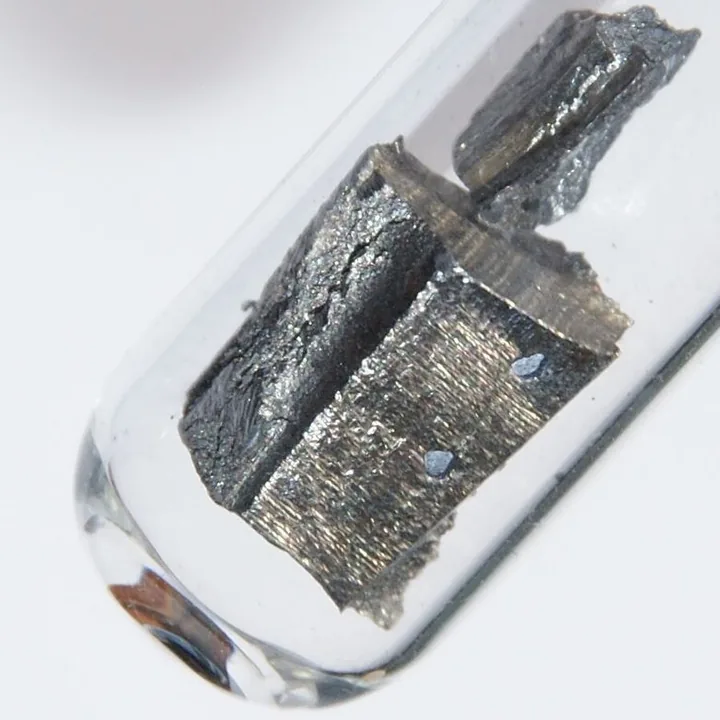
1Identity card
- Atomic number
- 60protons in the nucleus
- Symbol
- Nd
- Atomic weight
- 144.24 uIUPAC standard value : 144.242
- Family
- Lanthanides
- Group · period · block
- — (lanthanides) · 6 · f
- State at 20 °C
- solid
- Melting point
- 1,024 °C
- Boiling point
- 3,074 °C
- Density
- 7.01 g/cm³at 20 °C
- Electronegativity
- 1.14Pauling scale
- Electron configuration
- [Xe] 4f4 6s2
- Electrons per shell
- 2 · 8 · 18 · 22 · 8 · 2
- Earth’s crust
- 42 g per tonne
- Discovery
- 1885Carl Auer von Welsbach
- Place
- Vienna (Austria)
2The neodymium atom
An atom of neodymium has 60 protons in its nucleus and, when neutral, as many electrons, spread over 6 shells.
3Discovery
Like praseodymium, neodymium was separated from “didymium” in 1885, in Vienna, by Carl Auer von Welsbach. Its salts are a lilac colour that changes with the lighting.
4Origin of the name
From the Greek neos, “new”, and didymos, “twin”: the “new twin”.
5Where is it found?
Neodymium is almost as abundant as copper in the Earth’s crust. It is extracted from bastnäsite and monazite, mainly in China, which also dominates magnet manufacturing.
6Uses
- Neodymium–iron–boron magnets: electric-car motors, wind turbines, loudspeakers, hard drives, phone vibrators.
- Nd:YAG lasers for surgery, cutting and marking.
- A violet colouring for glass that turns blue or pink depending on the light.
7Did you know?
Neodymium magnets were invented in the early 1980s in Japan and the United States. A small magnet weighing a few grams can lift more than a thousand times its own weight.
Safety: Neodymium magnets can pinch fingers violently; swallowed, they are very dangerous.
8Isotopes
Seven natural isotopes; neodymium-142 is the most abundant (about 27%). Neodymium-143 is used, together with samarium-147, to date rocks.
Isotopes found in nature and their abundance (CIAAW data)
9Its neighbours in the table
Elements in the same column often have similar chemistry; those in the same row have the same number of electron shells.