Neptunium
Neptunium · Np · 93
The first “transuranium” element, heavier than uranium, made in 1940. A radioactive silvery metal that also exists in minute traces in uranium ores.
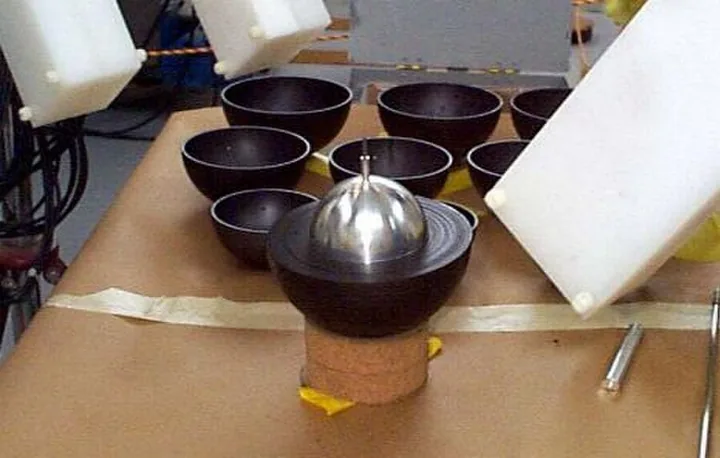
1Identity card
- Atomic number
- 93protons in the nucleus
- Symbol
- Np
- Atomic weight
- [237]mass number of the most stable known isotope
- Family
- Actinides
- Group · period · block
- — (actinides) · 7 · f
- State at 20 °C
- solid
- Melting point
- 639 °C
- Boiling point
- 4,174 °C estimated value
- Density
- 20.45 g/cm³at 20 °C
- Electronegativity
- 1.36Pauling scale
- Electron configuration
- [Rn] 5f4 6d1 7s2
- Electrons per shell
- 2 · 8 · 18 · 32 · 22 · 9 · 2
- Discovery
- 1940Edwin McMillan, Philip Abelson
- Place
- Berkeley (United States)
2The neptunium atom
An atom of neptunium has 93 protons in its nucleus and, when neutral, as many electrons, spread over 7 shells.
3Discovery
In 1940, at Berkeley, Edwin McMillan and Philip Abelson bombarded uranium with neutrons and identified a new element, number 93, formed when a uranium-239 nucleus transforms. It was the first element heavier than uranium ever obtained.
4Origin of the name
From Neptune, the planet that follows Uranus in the Solar System, just as element 93 follows uranium.
5Where is it found?
It forms in traces in uranium ores and, in larger amounts, in spent fuel from nuclear reactors.
6Uses
- Neptunium-237, the raw material for making the plutonium-238 used in space probes’ power generators.
- High-energy neutron detectors.
7Did you know?
McMillan shared the 1951 Nobel Prize in Chemistry with Glenn Seaborg for discovering the first transuranium elements.
Safety: Radioactive.
8Isotopes
No stable isotope. Neptunium-237, the longest-lived, has a half-life of 2.1 million years.
9Its neighbours in the table
Elements in the same column often have similar chemistry; those in the same row have the same number of electron shells.