Samarium
Samarium · Sm · 62
A silvery lanthanide that forms, with cobalt, magnets able to withstand high temperatures. Its name indirectly honours a Russian mining engineer.
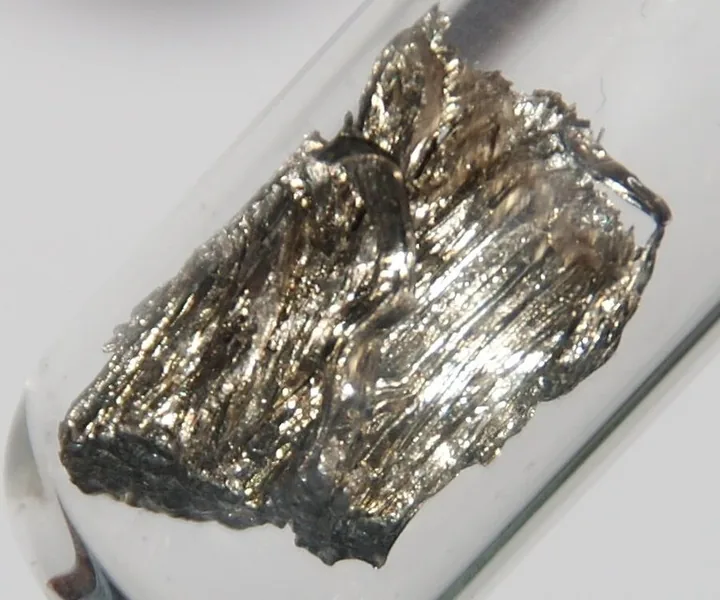
1Identity card
- Atomic number
- 62protons in the nucleus
- Symbol
- Sm
- Atomic weight
- 150.36 uIUPAC standard value
- Family
- Lanthanides
- Group · period · block
- — (lanthanides) · 6 · f
- State at 20 °C
- solid
- Melting point
- 1,072 °C
- Boiling point
- 1,794 °C
- Density
- 7.52 g/cm³at 20 °C
- Electronegativity
- 1.17Pauling scale
- Electron configuration
- [Xe] 4f6 6s2
- Electrons per shell
- 2 · 8 · 18 · 24 · 8 · 2
- Earth’s crust
- 7.0 g per tonne
- Discovery
- 1879Paul-Émile Lecoq de Boisbaudran
- Place
- Paris (France)
2The samarium atom
An atom of samarium has 62 protons in its nucleus and, when neutral, as many electrons, spread over 6 shells.
3Discovery
In 1879, in Paris, Paul-Émile Lecoq de Boisbaudran spotted unknown spectral lines in samarskite, a mineral from the Urals, and isolated the oxide of a new element.
4Origin of the name
From samarskite, a mineral named after the Russian engineer Vasili Samarsky-Bykhovets: it is the first element whose name recalls a real person, by way of a mineral.
5Where is it found?
It is extracted along with the other rare earths from monazite and bastnäsite.
6Uses
- Samarium–cobalt magnets, which keep their strength at high temperature (aerospace, micromotors, electric-guitar pickups).
- Samarium-153, to relieve pain from some bone cancers.
- Catalysts in organic chemistry.
7Did you know?
Samarium-147, naturally radioactive, very slowly turns into neodymium: geologists use it to date rocks billions of years old.
8Isotopes
Seven natural isotopes, including samarium-147 and samarium-148, which are very weakly radioactive. Samarium-149 strongly absorbs neutrons in reactors.
Isotopes found in nature and their abundance (CIAAW data)
9Its neighbours in the table
Elements in the same column often have similar chemistry; those in the same row have the same number of electron shells.