Americium
Américium · Am · 95
A radioactive silvery metal made in 1944. A few micrograms of americium keep watch over millions of homes in ionisation smoke detectors.
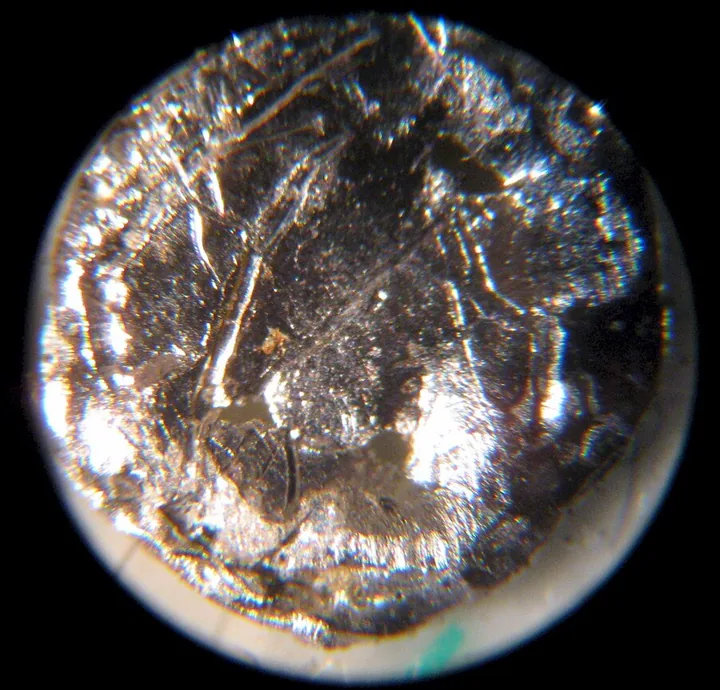
1Identity card
- Atomic number
- 95protons in the nucleus
- Symbol
- Am
- Atomic weight
- [243]mass number of the most stable known isotope
- Family
- Actinides
- Group · period · block
- — (actinides) · 7 · f
- State at 20 °C
- solid
- Melting point
- 1,176 °C
- Boiling point
- 2,011 °C
- Density
- 12 g/cm³at 20 °C
- Electronegativity
- 1.13Pauling scale
- Electron configuration
- [Rn] 5f7 7s2
- Electrons per shell
- 2 · 8 · 18 · 32 · 25 · 8 · 2
- Discovery
- 1944Glenn T. Seaborg, Ralph A. James, Leon O. Morgan, Albert Ghiorso
- Place
- Chicago (United States)
2The americium atom
An atom of americium has 95 protons in its nucleus and, when neutral, as many electrons, spread over 7 shells.
3Discovery
In 1944, at the University of Chicago’s Metallurgical Laboratory, Glenn Seaborg, Ralph James, Leon Morgan and Albert Ghiorso obtained element 95 by bombarding plutonium with neutrons in a reactor.
The still-secret discovery was revealed unexpectedly in November 1945: Seaborg announced it live on a children’s radio quiz show, in answer to a young listener’s question.
Want to know more about Seaborg and other scientists? Visit Les inventeurs, a sister site devoted to scientists and their inventions (in French).
4Origin of the name
From the Americas, by analogy with europium, which sits just above it in the table.
5Where is it found?
Americium does not occur in nature in noticeable amounts. It is recovered from spent nuclear reactor fuel.
6Uses
- Ionisation smoke detectors, which contain a minute amount of americium-241.
- Industrial thickness gauges and neutron sources.
- An energy source being considered for future European space missions.
7Did you know?
An ionisation smoke detector contains about a quarter of a millionth of a gram of americium, whose radiation makes the air slightly conductive; smoke interrupts this current and sets off the alarm.
Safety: Radioactive; detectors containing it must not be opened and are recycled through specialised channels.
8Isotopes
No stable isotope. Americium-243 is the longest-lived (about 7,400 years); americium-241 (432 years) is the most used.
9Its neighbours in the table
Elements in the same column often have similar chemistry; those in the same row have the same number of electron shells.