Gadolinium
Gadolinium · Gd · 64
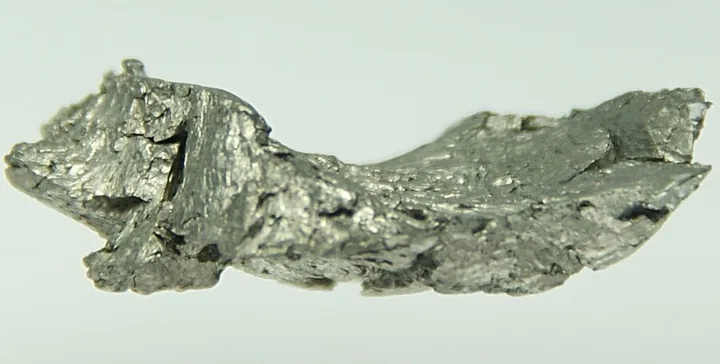
A silvery lanthanide with surprising magnetic properties: it is attracted by a magnet in a cool room, but no longer in a warm one. Its compounds brighten MRI images.
1Identity card
- Atomic number
- 64protons in the nucleus
- Symbol
- Gd
- Atomic weight
- 157.25 uIUPAC standard value
- Family
- Lanthanides
- Group · period · block
- — (lanthanides) · 6 · f
- State at 20 °C
- solid
- Melting point
- 1,313 °C
- Boiling point
- 3,273 °C
- Density
- 7.9 g/cm³at 20 °C
- Electronegativity
- 1.2Pauling scale
- Electron configuration
- [Xe] 4f7 5d1 6s2
- Electrons per shell
- 2 · 8 · 18 · 25 · 9 · 2
- Earth’s crust
- 6.2 g per tonne
- Discovery
- 1880Jean Charles Galissard de Marignac
- Place
- Geneva (Switzerland)
2The gadolinium atom
An atom of gadolinium has 64 protons in its nucleus and, when neutral, as many electrons, spread over 6 shells.
3Discovery
In 1880, in Geneva, Jean Charles Galissard de Marignac discovered the oxide of a new element in samarskite. In 1886 Paul-Émile Lecoq de Boisbaudran isolated this oxide and proposed the name gadolinium.
4Origin of the name
In honour of the Finnish chemist Johan Gadolin, a pioneer of rare-earth studies, who had given his name to the mineral gadolinite.
5Where is it found?
It is extracted with the other rare earths, mainly in China.
6Uses
- Contrast agents injected for MRI scans.
- Neutron absorber in nuclear reactors and radiation shielding.
- X-ray screens and detectors.
- Research into magnetic refrigeration, without refrigerant gas.
7Did you know?
Gadolinium becomes magnetic, like iron, below about 20 °C, and loses this behaviour above it.
Its isotope 157 absorbs slow neutrons better than any other stable isotope.
8Isotopes
Seven natural isotopes; gadolinium-158 is the most abundant (about 25%).
Isotopes found in nature and their abundance (CIAAW data)
9Its neighbours in the table
Elements in the same column often have similar chemistry; those in the same row have the same number of electron shells.