Terbium
Terbium · Tb · 65
A silvery lanthanide whose compounds glow brilliant green. It colours screens and goes into an alloy that changes length in a magnetic field.
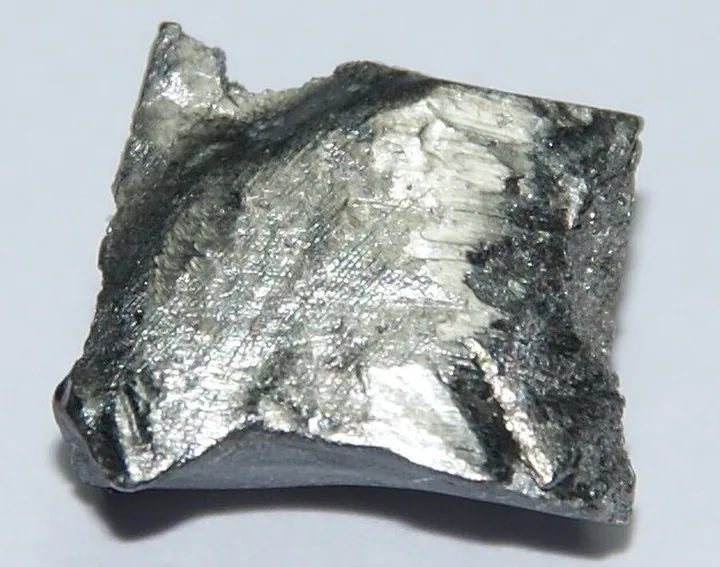
1Identity card
- Atomic number
- 65protons in the nucleus
- Symbol
- Tb
- Atomic weight
- 158.93 uIUPAC standard value : 158.925354
- Family
- Lanthanides
- Group · period · block
- — (lanthanides) · 6 · f
- State at 20 °C
- solid
- Melting point
- 1,356 °C
- Boiling point
- 3,230 °C
- Density
- 8.23 g/cm³at 20 °C
- Electronegativity
- not defined
- Electron configuration
- [Xe] 4f9 6s2
- Electrons per shell
- 2 · 8 · 18 · 27 · 8 · 2
- Earth’s crust
- 1.2 g per tonne
- Discovery
- 1843Carl Gustaf Mosander
- Place
- Stockholm (Sweden)
2The terbium atom
An atom of terbium has 65 protons in its nucleus and, when neutral, as many electrons, spread over 6 shells.
3Discovery
In 1843, in Stockholm, Carl Gustaf Mosander split yttria into three “earths” he named yttria, erbia and terbia. The names erbium and terbium were later swapped by other chemists, causing confusion that lasted decades.
4Origin of the name
From Ytterby, the Swedish village whose quarry gave its name to four elements.
5Where is it found?
It is one of the rarest lanthanides; it is extracted mainly from certain clays in southern China and from monazite.
6Uses
- Green phosphors in screens and energy-saving lamps.
- Terfenol-D, an alloy that stretches in a magnetic field: sonar, actuators, loudspeakers that make a table or window vibrate.
- Neodymium magnets meant to run hot (electric-car motors).
7Did you know?
Under ultraviolet light, terbium compounds light up with a green so pure that it lit up generations of screens.
8Isotopes
One stable isotope, terbium-159.
Isotopes found in nature and their abundance (CIAAW data)
9Its neighbours in the table
Elements in the same column often have similar chemistry; those in the same row have the same number of electron shells.